

FullEnrich Review 2026
Introduction
A B2B prospect list can look complete while still being practically unusable.
You may know a prospect's name, company, job title, or LinkedIn profile but have no reliable work email, no mobile number, outdated company information, or no way to determine whether the contact information is still usable. That gap is where data enrichment platforms become valuable.
FullEnrich takes a different approach from a traditional single-provider contact database. Instead of positioning itself primarily as a giant proprietary prospect database, it focuses on enriching existing people and company records by searching across multiple data sources through a waterfall model.
The basic idea is straightforward: when one source cannot provide a usable contact detail, FullEnrich can continue through other sources rather than stopping after the first failed lookup.
That sounds simple, but the real question is more complicated.
Does using multiple providers actually produce better usable data? How much does that coverage cost? How reliable are the resulting emails and phone numbers? Where does FullEnrich fit compared with Apollo, Clay, ZoomInfo, Cognism, or Hunter? And is the platform valuable enough to justify another data-enrichment subscription?
This FullEnrich review examines those questions from the perspective of sales teams, RevOps professionals, marketers, agencies, recruiters, developers, and GTM teams.
FullEnrich Quick Verdict
FullEnrich is best understood as a B2B contact enrichment and waterfall data platform rather than a conventional all-in-one sales engagement system.
Its strongest differentiator is the ability to combine multiple data providers behind one enrichment workflow. FullEnrich currently advertises waterfall enrichment across 25+ sources, verified work email and mobile enrichment, personal email enrichment, reverse email lookup, people/company search, CSV enrichment, API access, no-code integrations, CRM functionality, and an MCP server for AI-assisted workflows.
The pricing model is also unusual in an important way: FullEnrich charges credits primarily when it actually finds qualifying data rather than simply charging for every attempted lookup.
The current public Pro pricing starts at $55/month for 1,000 credits, with credits usable across different enrichment types. A work email costs 1 credit, a personal email 3 credits, a mobile phone 10 credits, and a reverse email lookup 1 credit. Company/person data is included with enrichment and is priced at 0.25 credit when exported independently.
The strongest reasons to consider FullEnrich
Multi-source waterfall enrichment
Strong focus on email and phone discovery
Pay-for-found-data credit model
CSV and bulk enrichment
API access
MCP support for AI assistants
No per-seat pricing
Credit rollover
CRM and automation integrations
Useful fit for existing prospect lists
The biggest limitations
FullEnrich is not necessarily the best choice if the primary requirement is a complete sales engagement platform, a massive self-contained prospecting database, or sophisticated outbound sequencing.
Data quality also remains dependent on the quality of the underlying sources, the input information provided, geography, and the particular person being searched. Multiple providers can improve the probability of finding information, but they cannot make every record correct.
Verdict: FullEnrich is particularly compelling for teams that already have prospects and need to turn incomplete records into actionable contact data. It is less compelling when the main requirement is an all-in-one database, sales engagement system, or enterprise sales-intelligence suite.
What Is FullEnrich?
FullEnrich is a B2B data enrichment platform designed to find and enrich professional contact information.
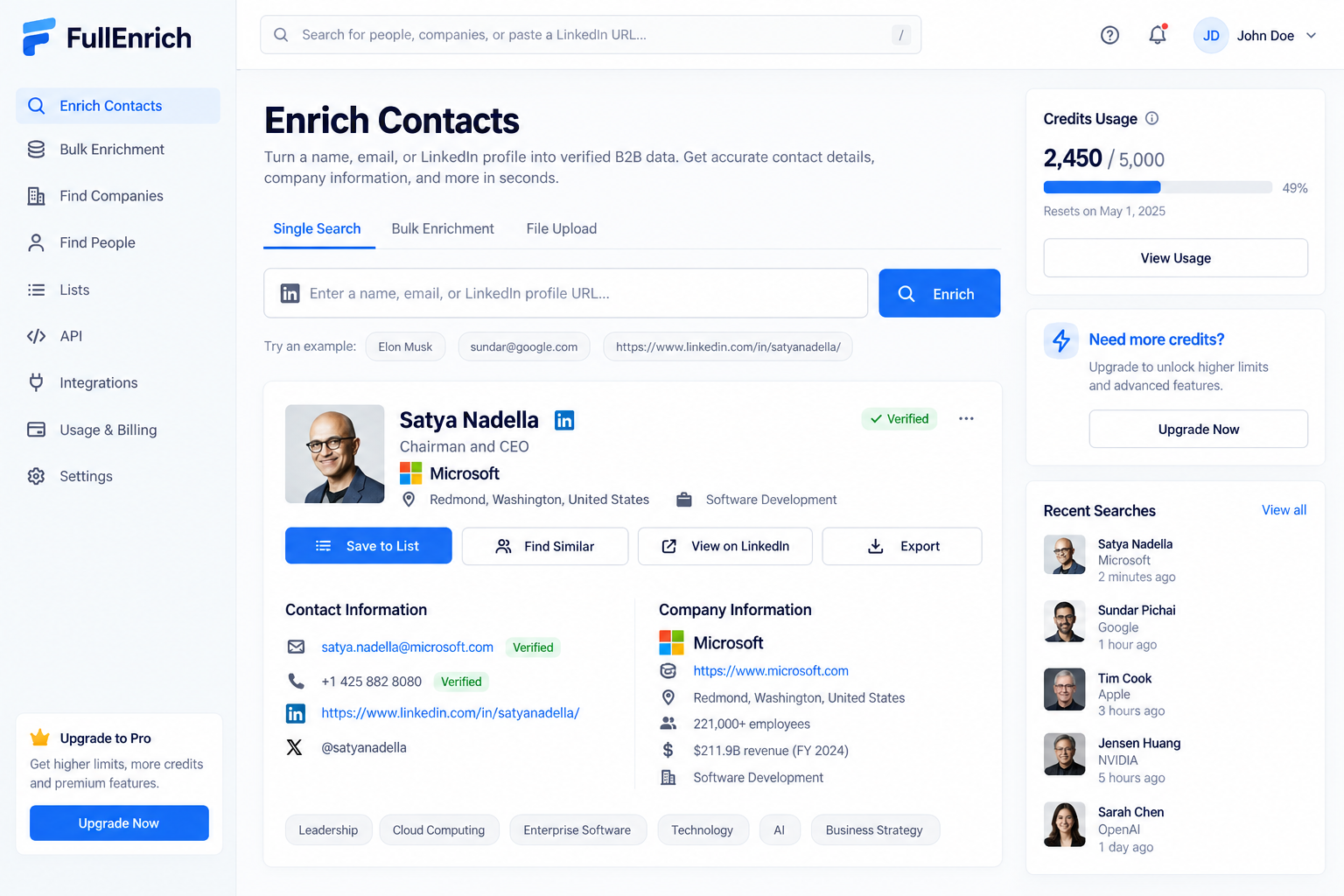
Its core use case is simple:
Give FullEnrich information about a person or company, and the platform attempts to return additional usable data.
That can include:
Work email
Mobile phone
Personal email
Person information
Company information
Reverse email information
Professional profile information
Firmographic data
The important distinction is between prospecting databases and enrichment platforms.
A traditional sales database generally asks:
"Who should I prospect?"
An enrichment platform asks:
"I already have this person or company. Can you tell me more about them?"
That distinction makes FullEnrich particularly useful when the starting dataset comes from another source.
For example, a company might already have:
5,000 CRM contacts
A CSV from an event
LinkedIn profile URLs
Names and company domains
Old leads
Recruiting candidates
Website leads
The problem is that those records may be incomplete.
FullEnrich can sit between that raw dataset and the downstream sales or marketing workflow.
A simplified architecture looks like this:
Existing data → FullEnrich → enrichment providers → verification → usable contact data → CRM/outreach/automation
That positioning is fundamentally different from simply buying access to a database and searching for contacts inside it.
How FullEnrich Works
The basic FullEnrich workflow is a waterfall.
Suppose a salesperson has:
First name
Last name
Company
LinkedIn URL
but does not have an email address or phone number.
FullEnrich uses the available identifiers to attempt enrichment.
A simplified workflow is:
The user submits the contact.
FullEnrich identifies the person and/or company.
The platform searches its available data sources.
If an applicable provider returns usable information, that result can be evaluated.
If the required information is not available, the workflow can continue to another source.
Email and phone verification layers are applied.
The resulting information is returned to the user or downstream system.
Credits are charged when qualifying data is found.
This is important because a conventional single-provider workflow might look like:
Contact → Provider A → found/not found
A waterfall workflow is closer to:
Contact → Provider A → Provider B → Provider C → Provider D → verification → result
The advantage is obvious: a provider that cannot identify a contact does not necessarily represent the end of the search.
But there is a critical caveat.
More providers do not automatically mean better data.
The quality of a waterfall depends on:
Provider quality
Provider selection
Matching logic
Deduplication
Verification
Source freshness
Geographic coverage
Input quality
How conflicting information is handled
This is why "number of providers" should not be treated as a standalone measure of data quality.
What Is Waterfall Enrichment?
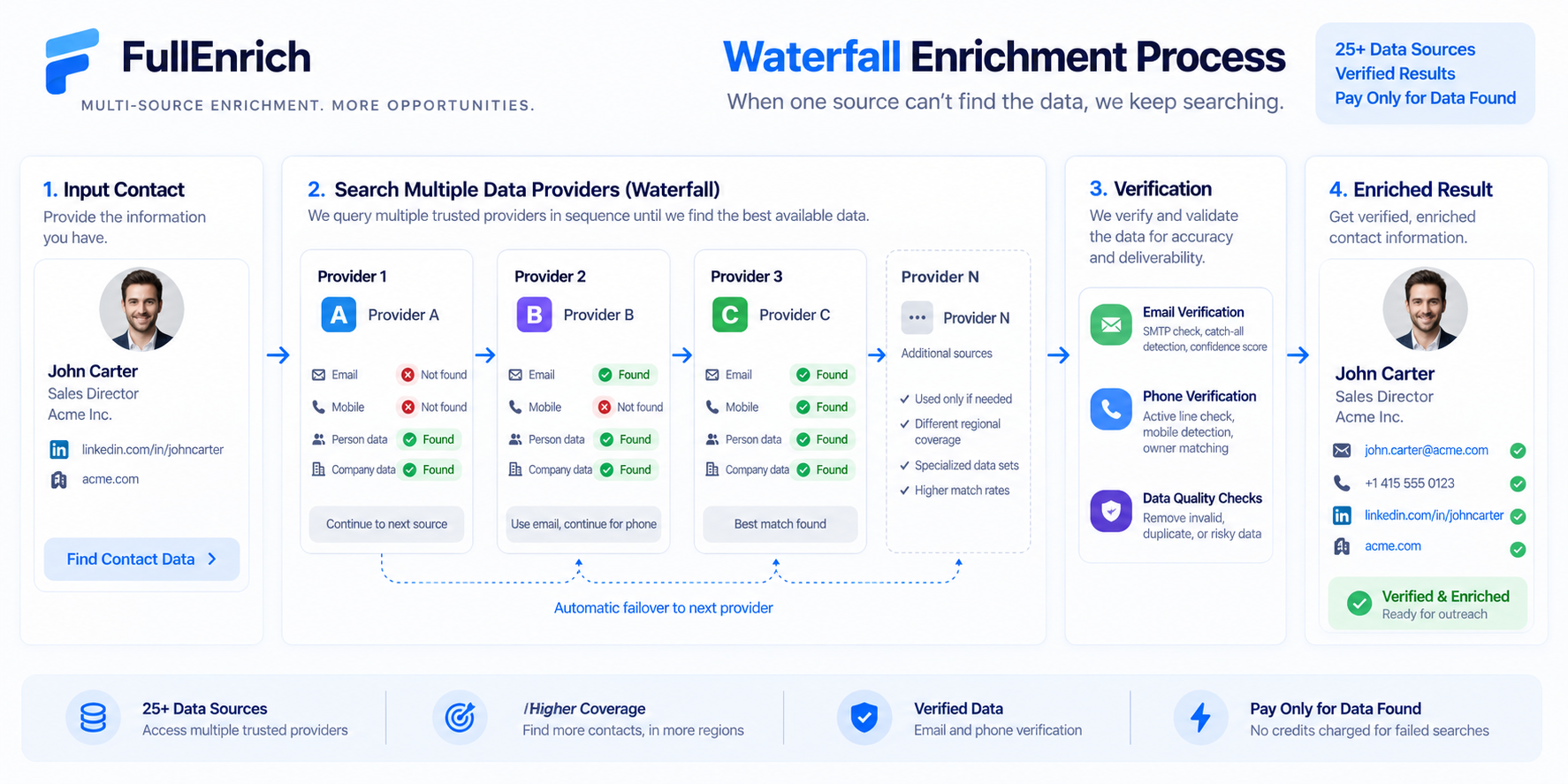
Waterfall enrichment is a strategy where multiple data sources are queried sequentially or according to an enrichment strategy instead of relying on a single provider.
Imagine a list of 1,000 prospects.
A conventional enrichment tool may send those 1,000 records to one provider. If that provider can only identify 650 usable email addresses, the other 350 records remain unresolved.
A waterfall system can continue searching for the missing records through additional providers.
The conceptual result is:
Provider A → unresolved contacts → Provider B → unresolved contacts → Provider C → verification
This has several potential advantages.
Higher potential coverage
Different databases have different strengths.
One provider may have better US data. Another may have better European coverage. Another may specialize in mobile numbers.
A waterfall system can exploit those differences without requiring the customer to maintain several vendor relationships.
Less vendor management
Instead of managing multiple enrichment APIs, accounts, billing systems, credentials, and workflows, the customer can use a single interface.
That can be particularly useful for:
RevOps
Agencies
GTM engineers
Developers
Data teams
Better failure handling
A failed result from one provider does not necessarily terminate the enrichment process.
But waterfall enrichment has trade-offs
A waterfall can introduce additional complexity.
Different providers may disagree.
For example:
Provider A says a person has one job title.
Provider B says another.
Provider C has a different phone number.
The system therefore needs good matching and verification logic.
Waterfall enrichment should consequently be evaluated on usable verified output, not merely the number of providers behind the system.
Why the Waterfall Model Matters
The waterfall model is most valuable when the target data is difficult to obtain.
Work emails can be relatively accessible for some professionals.
Mobile numbers are usually harder.
Personal emails can be even more difficult.
A platform that specializes in contact enrichment therefore faces a fundamentally different problem from a platform simply maintaining a large directory.
FullEnrich's public materials currently describe a waterfall spanning 25+ sources.
The commercial value of that model is straightforward: customers can potentially avoid purchasing several separate data providers.
The trade-off is that the customer pays FullEnrich for the convenience, orchestration, and verification layer.
This means FullEnrich's value proposition is not simply:
"We have more data."
It is closer to:
"We can search multiple sources for you and return usable data through one workflow."
That distinction is important when comparing FullEnrich with platforms such as Clay.
Clay can itself orchestrate multi-provider workflows, whereas FullEnrich packages waterfall enrichment as a core product capability.
Data Sources
FullEnrich currently describes its enrichment engine as using 25+ sources.
The important editorial point is that source count alone should not be treated as a guarantee of accuracy.
A good enrichment architecture needs to solve several problems:
Source selection
Which provider should be queried for a particular type of contact?
Matching
How does the platform determine that the returned record belongs to the requested individual?
Verification
Can the returned email or phone number actually be used?
Conflict handling
What happens if multiple providers disagree?
Freshness
How recently was the source information updated?
Geography
Does the provider perform equally well in North America, Europe, LATAM and APAC?
The fact that FullEnrich does not rely exclusively on a single database is strategically useful, but customers should still evaluate results on their own target audience.
A SaaS company selling primarily into the United States may see very different results from a recruiter searching for executives across several European markets.
Contact Enrichment
Contact enrichment is FullEnrich's central use case.
A contact can potentially be enriched with:
Work email
Personal email
Mobile phone
Person data
Company data
Professional information
The quality of the starting input matters.
A record containing only:
John Smith
is inherently difficult to match.
A record containing:
John Smith + Acme + acme.com + LinkedIn URL
provides significantly more context.
In general, stronger identifiers make it easier for any enrichment system to distinguish the correct person from people with similar names.
That means users should not think of enrichment as magic.
The platform can improve incomplete data, but the quality of the initial record still matters.
Email Enrichment
FullEnrich offers work email enrichment and personal email enrichment.
Work email discovery is generally the most commercially important use case for B2B sales.
A useful enrichment workflow needs to distinguish between simply finding a syntactically valid email and finding an email that is reasonably likely to be deliverable.
FullEnrich's current verification system includes:
Syntax and formatting checks
SMTP checks
Catch-all verification
Confidence scoring
Email verification
The company also states that its advanced verification removes a substantial amount of raw data before presenting results.
The distinction matters.
An email can be:
Syntactically valid
Deliverable
High probability
Catch-all
Invalid
Unknown/risky
These are not interchangeable categories.
A syntactically correct address such as john@example.com does not automatically mean that sending an email to it is safe.
Likewise, no verification system can guarantee that an email will remain deliverable indefinitely.
People change companies.
Domains expire.
Mail servers change.
Security systems change.
Therefore, FullEnrich should be viewed as a tool for improving confidence in contact data rather than as a guarantee of zero-bounce outreach.
Mobile Phone Enrichment
Mobile enrichment is one of FullEnrich's more commercially important differentiators.
The current public credit model charges 10 credits for a verified mobile phone, compared with 1 credit for a work email.
That price difference reflects the economics and scarcity of phone data.
Phone numbers are particularly valuable for:
Enterprise sales
SDR teams
Account executives
Recruiting
Executive search
High-value outbound
International sales
The platform also describes phone verification mechanisms including:
Active/out-of-service checking
Landline identification
Owner-name verification for US and Canada
The distinction between a number existing and a number belonging to the intended person is crucial.
A number that is active but belongs to an assistant, former employee, office line, or another household member is not equivalent to a verified direct mobile.
Independent user feedback reflects this nuance. G2 reviews include positive comments about phone accuracy but also reports of incorrect numbers or cases where users wanted stronger person-to-number matching.
That makes phone enrichment an area where users should validate results against their own audience.
Personal Email Enrichment
FullEnrich also supports personal email enrichment.
The current public price is 3 credits for a verified personal email.
Personal email data can be useful in particular situations, such as:
Recruiting
Executive search
Re-engaging old contacts
Identifying alternate contact channels
Certain lead-generation workflows
However, personal contact information requires more careful handling than ordinary professional data.
The fact that a platform can technically provide a personal email does not mean that every possible use of it is appropriate.
Companies should consider:
Applicable privacy laws
Lawful basis
Notice requirements
Outreach rules
Internal data policies
Regional restrictions
Whether the intended use is proportionate
This is especially important for international campaigns.
Reverse Email Lookup
Reverse Email Lookup works in the opposite direction from ordinary enrichment.
Instead of starting with:
Person → find email
the workflow becomes:
Email → identify person/company
FullEnrich currently prices reverse email lookup at 1 credit when a result is found.
This can be useful for:
Unknown inbound leads
Existing CRM records
Email-list cleanup
Identifying contacts
Company matching
Lead qualification
For example, imagine receiving an email from:
jane@company.com
but your CRM has no useful information about Jane.
Reverse lookup can potentially turn that email into a person and company profile.
This is especially useful in workflows where the email address is known but the CRM record is incomplete.
Person Enrichment
Person enrichment adds contextual information around an individual.
Depending on the available record, this can include:
Name
Job title
Company
Seniority
Professional profile
Contact information
Career-related information
For sales teams, person enrichment is useful because the contact itself is often more important than the company.
Knowing that a company exists is not enough.
The sales team needs to know:
Who actually owns the problem?
Person-level data helps identify decision-makers, influencers and relevant stakeholders.
Company Enrichment
Company enrichment adds information around the organization.
Relevant information can include:
Company name
Website
Industry
Headcount
Location
Company type
Firmographic information
Company data is particularly useful for ICP qualification.
For example:
A company may want to target:
SaaS companies
50–500 employees
North America
Specific industries
Specific job functions
Company enrichment can help transform a basic contact list into a more useful account-level dataset.
Search & Contact Discovery
FullEnrich also provides people and company search.
The current product advertises more than 30 filters for people and company search.
Search is useful when the user does not yet have a complete prospect list.
A typical ICP workflow might look like:
Define target industry.
Select company size.
Select geography.
Select relevant job titles.
Narrow by seniority.
Review prospects.
Export or enrich selected records.
Push the results into the next GTM workflow.
This moves FullEnrich slightly beyond pure enrichment.
The distinction remains important, though.
A user primarily looking for a giant prospecting database with sophisticated intent signals may prefer a broader sales-intelligence platform.
FullEnrich becomes especially attractive when search and enrichment are part of the same workflow.
Bulk CSV/Excel Enrichment
Bulk enrichment is one of the most practical FullEnrich workflows.
The general process is:
Prepare a CSV or Excel file.
Include the strongest identifiers available.
Upload the file.
Map the input columns.
Select the desired enrichment types.
Run enrichment.
Review the returned records.
Export or send the results into another workflow.
This can be useful for:
Event attendee lists
Old CRM exports
Purchased lead lists
Recruiting databases
Sales prospect lists
Existing customer data
Incomplete company records
A major advantage is that teams do not necessarily have to manually search every contact.
That makes bulk enrichment particularly valuable for agencies and RevOps teams.
CRM Integrations
FullEnrich's integration ecosystem includes CRM functionality, with HubSpot currently documented.
The HubSpot integration allows users to select HubSpot lists and choose enrichment fields such as:
Work email
Mobile phone
Both
The enrichment results can then be written back to HubSpot according to field mapping.
The documented HubSpot workflow supports batches of up to 5,000 contacts per run.
That is a useful operational feature because it eliminates a common manual process:
Export CRM → CSV → enrich externally → download → clean → re-import CRM
Instead:
CRM → FullEnrich → enriched CRM
This is precisely the kind of workflow where an enrichment platform can create operational value beyond simply finding contact data.
No-Code Integrations
FullEnrich's integration page currently lists no-code and automation connectivity including platforms such as Zapier and Make.
The value of these integrations is not merely convenience.
They allow enrichment to become a workflow component.
For example:
New CRM lead → FullEnrich → enrich email/phone → update CRM → route lead
Or:
New form submission → FullEnrich → company enrichment → lead qualification → sales notification
This is where enrichment starts becoming part of RevOps infrastructure rather than a standalone research tool.
API
FullEnrich provides API access for teams that need enrichment inside their own applications or automated pipelines.
The API becomes useful when enrichment needs to happen automatically.
Instead of:
Employee → upload CSV → wait → download
the workflow becomes:
Application → API → enrichment → structured result → application
Possible use cases include:
CRM automation
Form enrichment
Lead routing
Internal prospecting tools
Data pipelines
Automated qualification
Productized enrichment
Embedded workflows
High-volume processing
FullEnrich's own API material specifically describes real-time enrichment scenarios such as form submissions, CRM updates and webhook-triggered workflows.
The API is therefore more relevant to technical teams than to an individual salesperson who only needs occasional lookups.
Manual Enrichment vs CSV vs No-Code vs API
Workflow | Best for | Main advantage | Main limitation |
|---|---|---|---|
Manual UI | Individual prospecting | Simple and visual | Doesn't scale |
CSV enrichment | Lists and batch operations | Easy bulk processing | Less real-time |
No-code | RevOps and automation | Little development required | Workflow flexibility depends on integrations |
API | Developers and products | Maximum automation | Requires technical implementation |
The key point is that these are not necessarily competing methods.
A mature GTM organization may use all four.
A salesperson may use the UI.
RevOps may use HubSpot or Zapier.
A data team may use the API.
An AI agent may use MCP.
MCP & AI Agents
MCP is one of FullEnrich's more interesting recent additions.
The Model Context Protocol allows an AI assistant or agent to interact with external tools in a structured way.
FullEnrich provides an MCP server that can connect AI clients to its enrichment capabilities.
The documented workflow allows an AI assistant to:
Search for people
Search for companies
Enrich contacts
Find emails
Find phone numbers
Run batch enrichment
Export results
Work with CSV/JSON output
The workflow can look like:
AI agent → FullEnrich MCP → prospect search → enrichment → verified data → AI analysis
For example, instead of manually constructing a search, a user could ask an AI assistant to find marketing directors at software companies in the United States, review the results, and then request enrichment for selected contacts.
The important detail is that FullEnrich's MCP workflow includes a confirmation step before enrichment, so enrichment actions are not intended to silently consume credits.
Search can also provide a free preview before exporting results, while exported search results consume credits.
Why MCP Matters
The larger significance is not simply that FullEnrich has an AI integration.
It is that contact enrichment is becoming an agent-accessible infrastructure layer.
An AI agent can potentially combine:
Prospect research
Data enrichment
Company research
Qualification
Personalization
CRM updates
Outreach preparation
That can substantially reduce manual work.
But it also increases the importance of data quality.
If an AI agent receives incorrect information, it can propagate that error into:
Lead scoring
CRM records
Personalization
Sales messaging
Automated outreach
The faster the automation, the faster bad data can spread.
Therefore, MCP should not be interpreted as eliminating the need for verification or human oversight.
Data Verification
Verification is arguably more important than raw data acquisition.
FullEnrich's public documentation describes several verification layers.
Email verification
Current documented checks include:
Syntax and formatting
SMTP checks
Catch-all verification
Confidence scoring
FullEnrich also states that its catch-all verification system verifies a substantial percentage of catch-all addresses.
The important point is that catch-all domains are inherently more complicated.
A catch-all domain can accept messages for multiple addresses regardless of whether a specific mailbox is actively monitored.
Therefore, "catch-all verified" should not be interpreted as equivalent to an ordinary confirmed mailbox.
Phone verification
Phone verification includes:
Landline detection
Out-of-service removal
Mobile identification
Owner-name verification for US and Canada
This can improve the usefulness of phone data compared with simply returning an unverified number.
Still, verification should be viewed probabilistically.
A phone number can change owners.
A person can leave a company.
A business number can be reassigned.
Verification reduces risk; it does not eliminate it.
Data Quality
A useful framework for evaluating FullEnrich is to separate data quality into five dimensions.
Accuracy
Does the data belong to the correct person?
Coverage
How often can FullEnrich return something useful?
Freshness
How recently was the information updated?
Verification
How much confidence exists that the contact method works?
Completeness
How much of the record is populated?
FullEnrich publicly estimates average email and phone find rates at around 80%, while noting that performance varies considerably by industry and geography.
That should be treated as a company estimate, not an independently verified universal accuracy benchmark.
Independent reviews provide a more mixed but generally positive picture.
G2 currently shows FullEnrich at 4.8/5, with hundreds of reviews across its product listing. Review themes frequently mention ease of use, data accuracy, contact information quality and speed.
At the same time, G2 feedback also includes complaints involving incorrect phone numbers, missing emails, slow processing, integration limitations and perceived pricing.
That combination is more informative than either extreme.
FullEnrich appears to have strong user satisfaction overall, but enrichment quality is not uniform for every contact.
Geographic Coverage
B2B data quality varies heavily by geography.
A provider can perform very well in the United States and differently in:
France
Germany
United Kingdom
Eastern Europe
LATAM
India
Southeast Asia
Australia
This happens because business data is fragmented across markets.
Phone-number availability also varies by country.
Privacy regulations differ.
Company naming conventions differ.
Professional profiles differ.
Database coverage differs.
FullEnrich itself acknowledges that find rates vary by geography.
For international sales teams, the correct approach is therefore not to assume that a global marketing claim equals uniform global performance.
A better approach is to run a representative test against the exact countries and industries the company intends to target.
Sales Use Cases
Cold outbound
A typical workflow is:
Build an ICP list.
Import contacts into FullEnrich.
Find work emails and/or mobile phones.
Verify results.
Push the records into an outreach platform.
Launch outreach.
The primary benefit is improving reachability.
The limitation is that better contact data does not automatically mean better prospects.
Targeting remains critical.
Account-based selling
FullEnrich can help sales teams enrich several stakeholders within a target account.
For example:
CEO
VP Sales
VP Marketing
Head of Operations
Procurement
Technical decision-maker
The enrichment layer can help transform a company-level account list into a multi-contact buying committee.
Enterprise prospecting
Enterprise sales often require phone numbers because email alone may not be enough.
Mobile enrichment can therefore be particularly valuable for high-value accounts.
The economics also make more sense when one successful contact can be commercially valuable.
CRM enrichment
Instead of asking salespeople to manually research incomplete records, RevOps can run enrichment against CRM data.
This can improve:
Contact completeness
Routing
Segmentation
Lead scoring
Account ownership
Reporting
Marketing Use Cases
Marketing teams can use enrichment for:
Form enrichment
Lead qualification
Segmentation
Account-based marketing
CRM cleanup
Personalization
Lead routing
A form may only collect:
Name + email
Enrichment can potentially add:
Company + role + seniority + firmographic information + phone
This reduces friction for the prospect while giving marketing more context.
The challenge is that organizations should carefully consider data privacy and notice requirements when enriching personal information.
Recruiting Use Cases
Recruiters can use enrichment to:
Complete candidate records
Find additional contact channels
Enrich executive profiles
Build talent databases
Support sourcing
Research hiring targets
The value can be especially high in executive search.
But recruiting also presents privacy considerations because the data concerns individuals rather than generic business entities.
Organizations should therefore ensure that enrichment and outreach processes comply with applicable privacy and employment-related requirements.
Agency Use Cases
Agencies are a natural customer segment for a credit-based enrichment system.
An agency may have:
Client A's list
Client B's list
Client C's CRM
Client D's campaign
Rather than purchasing separate enrichment systems for each client, an agency can centralize enrichment.
FullEnrich's enterprise offering also explicitly addresses agencies, including multi-client workflows and agency-specific commercial arrangements.
For agencies, the important variables are:
Credits
Volume
Client separation
API access
Automation
Reporting
Reusability
An agency doing occasional enrichment may find the standard product sufficient.
A high-volume agency may need enterprise terms.
GTM & RevOps Use Cases
RevOps is where FullEnrich becomes especially interesting.
The platform can sit inside a broader architecture:
CRM → enrichment → qualification → routing → outreach → reporting
Possible applications include:
CRM hygiene
Missing-field completion
Contact enrichment
Account enrichment
Lead scoring
Routing
Automated workflows
Data standardization
The strongest use case is not simply "find emails."
It is:
Make contact data available at the exact point in the revenue process where it is needed.
That is a much more strategic role.
FullEnrich Pricing
FullEnrich currently publishes pricing publicly.
The current public Pro starting point is:
$55/month for 1,000 credits.
The platform also provides a free trial with 50 starting credits and no credit card requirement.
Enterprise pricing is custom.
The Pro plan currently includes:
Waterfall enrichment
Work email enrichment
Mobile phone enrichment
Personal email enrichment
Reverse email lookup
Verification
People/company search
CRM integrations
API
No-code integrations
MCP
Unlimited users
Credit rollover
The public pricing page also advertises lower per-credit pricing at higher volumes.
Because pricing can change, the live FullEnrich pricing page should always be treated as the final source when making a purchase decision.
FullEnrich Credit System
Data type | Current credit cost |
|---|---|
Work email | 1 credit |
Mobile phone | 10 credits |
Personal email | 3 credits |
Reverse email lookup | 1 credit |
Person/company export | 0.25 credit |
Failed enrichment | 0 credits |
This is one of the most important parts of the FullEnrich business model.
The platform says credits are consumed when qualifying data is found.
That means unsuccessful enrichment attempts generally do not consume credits.
The model is particularly attractive for difficult datasets.
Suppose a team has 1,000 contacts.
If another provider charges for every lookup regardless of whether useful data is returned, the customer pays for 1,000 attempts.
FullEnrich's model is closer to:
Pay when qualifying information is found.
That changes the economics of enrichment.
Credit Rollover
Credit rollover is another important part of the pricing structure.
Current documentation states:
Monthly credits remain valid for 3 months.
Annual credits remain valid for 12 months.
This is more useful than a strict "use it or lose it at the end of every month" system.
It is particularly useful for agencies and teams with irregular workloads.
For example, an agency might have:
Low usage in January
Low usage in February
A large client campaign in March
Rollover gives those teams more flexibility.
However, users should understand the distinction between credit rollover and unlimited lifetime storage.
Credits have validity periods.
Cost-Effectiveness
The most useful way to evaluate FullEnrich is not:
"Is $55 cheap?"
Instead ask:
"How much does a successfully enriched reachable contact cost?"
For work email:
1 credit
For mobile:
10 credits
For personal email:
3 credits
This creates very different economics depending on the use case.
If a sales team primarily needs work emails, the platform can potentially be very cost-efficient.
If the team wants mobile numbers for nearly every prospect, credit consumption increases much faster.
That means FullEnrich is not automatically cheap or expensive.
Its economics depend heavily on the enrichment mix.
Pricing Scenarios
Solo founder
A solo founder doing moderate outbound may benefit from the smaller credit plans.
The main attraction is not unlimited prospecting but the ability to enrich selected high-value prospects.
Startup
A startup with a small sales team can use shared credits across users.
Unlimited users also removes a common per-seat pricing concern.
SDR team
An SDR team doing high-volume enrichment needs to model credit consumption carefully.
Work email-heavy workflows are much cheaper than phone-heavy workflows.
Enterprise sales team
Enterprise organizations may benefit from custom rates, rate limits, priority queues, security options and account management.
Recruiting agency
Recruiters may find the phone and personal-email capabilities useful, but should calculate consumption carefully because phone enrichment costs significantly more credits.
Lead generation agency
Agencies can potentially benefit from shared infrastructure across multiple client campaigns.
API product
Companies embedding enrichment inside their own products should investigate Enterprise terms and reseller/API arrangements rather than assuming standard Pro pricing applies.
FullEnrich vs a Single Data Provider
A single-provider workflow has one major advantage:
simplicity.
You know where your data comes from.
But it also creates a single point of failure.
If the provider cannot find a phone number, the workflow stops.
FullEnrich's waterfall model is designed to reduce that problem.
Factor | Single provider | FullEnrich waterfall |
|---|---|---|
Data sources | One | Multiple |
Vendor management | Simple | Centralized through FullEnrich |
Potential coverage | Provider-dependent | Potentially broader |
Verification | Provider-specific | FullEnrich verification layer |
Cost model | Varies | Credit-based |
Complexity for user | Low | Low at UI level |
Underlying complexity | Lower | Higher |
The biggest conceptual advantage of FullEnrich is therefore abstraction.
The customer does not have to manage every individual provider.
FullEnrich vs Apollo
Apollo and FullEnrich overlap, but they are fundamentally different products.
Apollo is more oriented toward an integrated prospecting and sales-engagement workflow.
FullEnrich is more focused on enrichment.
Factor | FullEnrich | Apollo |
|---|---|---|
Core strength | Waterfall enrichment | Prospecting + sales engagement |
Multi-provider enrichment | Strong focus | Less central |
Phone enrichment | Core feature | Available |
Work email | Core feature | Core feature |
Outreach | Not its primary focus | Major capability |
Database | Search + enrichment | Large prospect database |
API | Yes | Yes |
Best for | Existing/incomplete data | Prospecting + outreach |
Workflow philosophy | Enrichment infrastructure | Sales platform |
Choose FullEnrich when:
You already have leads and need better contact data.
Choose Apollo when:
You want one platform combining prospect discovery, contact data and outbound execution.
They can also complement each other.
A company could discover contacts through one platform and use another enrichment provider to improve difficult records.
FullEnrich vs Clay
This is probably the most nuanced comparison.
Clay is fundamentally a GTM workflow orchestration platform.
FullEnrich is fundamentally an enrichment provider/platform.
Clay can connect multiple data providers and construct complex enrichment workflows.
FullEnrich packages a multi-provider waterfall directly into its product.
Factor | FullEnrich | Clay |
|---|---|---|
Waterfall enrichment | Core capability | Core workflow capability |
Multi-provider orchestration | Built in | Extensive |
Workflow builder | More focused | Very strong |
AI research | MCP/AI integrations | Claygent and AI workflows |
CRM automation | Available | Strong |
Data marketplace | More focused | Broad provider ecosystem |
API | Yes | Higher-tier/API capabilities |
Complexity | Lower for direct enrichment | Higher but more flexible |
Best for | Contact enrichment | GTM orchestration |
The relationship is therefore not always competitive.
They can be complementary.
A GTM engineer could use Clay as the orchestration layer and FullEnrich as one of the enrichment engines.
Alternatively, a company that simply wants waterfall contact enrichment may find FullEnrich much simpler.
FullEnrich vs ZoomInfo
ZoomInfo is much broader in enterprise sales intelligence.
It is designed around:
Sales intelligence
Company intelligence
Contact data
Intent
Enterprise workflows
Sales and marketing operations
FullEnrich is more focused.
This creates an important distinction.
A large enterprise that needs a comprehensive intelligence platform may prefer ZoomInfo.
A team that already has a prospect list and primarily wants reliable enrichment may prefer FullEnrich.
The products should therefore not be evaluated purely on the number of contacts they contain.
They solve different operational problems.
FullEnrich vs Cognism
Cognism is another enterprise-oriented sales intelligence platform with a strong emphasis on compliant B2B data and mobile coverage.
Its current commercial model includes prospecting, CRM enrichment and data-as-a-service options.
FullEnrich differs primarily through its waterfall enrichment architecture and usage-oriented credit system.
Cognism may be more appropriate for:
Enterprise prospecting
Large sales organizations
Dedicated sales-intelligence workflows
Organizations wanting a broader intelligence platform
FullEnrich may be more attractive for:
Enrichment
Existing datasets
API workflows
Agencies
GTM engineers
AI-agent workflows
FullEnrich vs Hunter
Hunter has historically been particularly strong around email discovery and verification.
Its current platform has expanded beyond simple email lookup into B2B discovery, enrichment and outbound sequencing.
Need | Better fit |
|---|---|
Work email discovery | Both |
Email verification | Both |
Phone enrichment | FullEnrich |
Waterfall enrichment | FullEnrich |
Email outreach | Hunter |
Email-focused workflows | Hunter |
Multi-source enrichment | FullEnrich |
AI/MCP enrichment workflows | FullEnrich |
Full outbound platform | Hunter |
If the primary requirement is email discovery and cold-email execution, Hunter can be compelling.
If the requirement includes mobile numbers and multi-provider waterfall enrichment, FullEnrich becomes more interesting.
Competitor Comparison
Platform | Best known for | Waterfall / multi-source | Outreach | Enterprise intelligence | Best fit |
|---|---|---|---|---|---|
FullEnrich | Contact enrichment | Yes | Limited/core not primary | Moderate | Enrichment-focused GTM |
Apollo | Prospecting + outreach | Limited | Yes | Moderate | Sales teams |
Clay | GTM orchestration | Yes | Via integrations/tools | Moderate | GTM engineers |
ZoomInfo | Sales intelligence | Broad data platform | Yes/ecosystem | Strong | Enterprise |
Cognism | B2B data + prospecting | Data platform | Ecosystem | Strong | Enterprise/international |
Hunter | Email discovery + outreach | Limited | Yes | Moderate | Email-focused teams |
The right choice depends less on which product has the longest feature list and more on where the company wants the product to sit in its stack.
Top 15 FullEnrich Features Worth Knowing
1. Waterfall enrichment
The defining capability.
Multiple sources are used to improve the likelihood of finding contact information.
Best for: hard-to-find contacts.
Limitation: multiple sources do not guarantee accuracy.
2. Work email enrichment
Finds professional email addresses.
Best for: outbound sales.
Limitation: email addresses can become outdated.
3. Mobile enrichment
Finds verified mobile numbers.
Best for: high-value outbound and recruiting.
Limitation: relatively high credit cost.
4. Personal email enrichment
Provides an alternate contact channel.
Best for: recruiting and specific re-engagement workflows.
Limitation: increased privacy considerations.
5. Reverse email lookup
Starts with an email and works toward the associated person/company.
Best for: CRM enrichment and inbound lead identification.
6. Email verification
Adds confidence around email usability.
Best for: reducing risky outreach.
7. Catch-all verification
Helps distinguish catch-all domains from more conventional verified addresses.
Best for: improving email-quality decisions.
8. Confidence scoring
Provides additional context about the returned data.
Best for: deciding which records deserve priority.
9. Phone verification
Adds validation beyond simply returning a number.
10. People search
Helps discover prospects matching target criteria.
11. Company search
Supports account discovery and ICP targeting.
12. CSV enrichment
Useful for bulk operations.
13. CRM workflows
Allows enrichment to happen inside revenue processes.
14. API
Turns FullEnrich into infrastructure rather than just a user interface.
15. MCP
Makes enrichment accessible to AI assistants and agents.
Pros & Cons
Pros
Strong focus on contact enrichment
Multi-provider waterfall architecture
Work email enrichment
Mobile phone enrichment
Personal email enrichment
Reverse email lookup
Verification layers
Bulk CSV enrichment
API
MCP
No-code integrations
Unlimited users
Credit rollover
Pay-for-found-data model
Useful for agencies and RevOps
Cons
Phone enrichment consumes credits quickly
Data quality can vary by contact and geography
Multiple providers cannot eliminate incorrect data
Not a complete replacement for a sales engagement platform
Some users report missing emails or incorrect phone numbers
Some users want deeper CRM/integration functionality
The product may be less suitable for teams that primarily want a giant prospect database
Some users consider pricing expensive for high-volume phone enrichment
Customer Reviews
Independent G2 feedback is generally positive.
The current G2 listing shows a high overall rating, with users frequently praising:
Ease of use
Data accuracy
Contact information
Speed
Prospecting efficiency
Users also report several recurring criticisms:
Incorrect phone numbers
Missing emails
Pricing concerns
Integration issues
Slow loading or processing
Desire for a LinkedIn/Chrome extension
This is an important distinction.
The customer sentiment is not:
"Every record is perfect."
It is closer to:
"The platform is generally effective at improving difficult contact lists, but individual data quality still varies."
That is exactly what one should expect from a multi-source enrichment system.
User Sentiment Analysis
What users consistently like
The strongest recurring theme is simplicity combined with contact coverage.
Users often describe FullEnrich as easier than managing several individual enrichment providers.
Another recurring theme is phone data.
Several reviewers specifically highlight the ability to obtain phone numbers that were difficult to find elsewhere.
What users criticize
The most important negative theme is incorrect or incomplete data.
This is not surprising.
Contact enrichment is probabilistic.
A phone number can be active but associated with the wrong individual.
An email can exist but no longer be actively monitored.
A person can change companies.
The other recurring concern is cost, particularly for phone enrichment.
That makes credit economics important.
Security & Compliance
FullEnrich currently states that it is:
GDPR compliant
CCPA compliant
SOC 2 Type II certified
The company provides a Trust Center and legal/security documentation.
These claims should be distinguished carefully.
A platform's compliance status does not mean that every possible customer use of its data is automatically lawful.
For example:
Platform compliance ≠ customer campaign compliance.
A customer still needs to consider:
Purpose of processing
Lawful basis
Notice
Opt-out requirements
Marketing regulations
Jurisdiction
Internal data governance
This distinction is particularly important when personal emails or phone numbers are involved.
Data Privacy
The privacy question becomes more complicated as enrichment becomes more comprehensive.
Professional information is still personal data in many jurisdictions.
Personal email addresses and phone numbers are even more sensitive from a practical privacy perspective.
Companies using FullEnrich should establish policies around:
What data is enriched
Why it is enriched
How it is stored
How long it is retained
Who can access it
How opt-outs are processed
Where the data is transferred
How the information is used for outreach
For European operations, GDPR considerations should be integrated into the entire workflow rather than treated as a checkbox at the vendor-selection stage.
Practical FullEnrich Workflows
Workflow 1 — Cold Outbound
Build an ICP list.
Upload contacts.
Enrich work emails.
Enrich mobile numbers for high-value prospects.
Verify results.
Export to the outreach platform.
Launch personalized outreach.
Monitor responses and bounces.
Workflow 2 — CRM Enrichment
Select CRM contacts.
Identify missing fields.
Send selected records to FullEnrich.
Enrich email and phone fields.
Verify results.
Write results back into CRM.
Use enriched data for segmentation and routing.
Workflow 3 — Inbound Lead Enrichment
Visitor submits a form.
Lead enters CRM.
FullEnrich enriches the contact.
Company and person information are added.
Lead scoring is applied.
Qualified lead is routed to sales.
The benefit is that the salesperson receives a more complete record without requiring the prospect to fill out a long form.
Workflow 4 — Recruiting
Build a candidate list.
Add candidate identifiers.
Enrich contact information.
Verify contact methods.
Add results to recruiting workflow.
Contact candidates through appropriate channels.
Privacy and applicable recruiting regulations should remain part of the process.
Workflow 5 — Agency
Receive client list.
Normalize data.
Upload to FullEnrich.
Enrich required fields.
Verify results.
Export to client CRM or outreach platform.
Report enrichment outcomes to the client.
Workflow 6 — AI Agent
User gives the AI agent a prospecting instruction.
Agent searches FullEnrich through MCP.
User reviews the search preview.
Agent enriches selected contacts.
FullEnrich returns structured information.
AI analyzes the contacts.
AI can prepare personalization or workflow outputs.
Human reviews before consequential outreach.
The final step remains important.
AI can automate research, but automation should not eliminate judgment.
FullEnrich for AI-Powered GTM
The combination of enrichment and AI is potentially more important than the individual MCP feature.
Consider a traditional workflow:
Salesperson → search → copy data → enrich → research → write message
An AI-assisted workflow can become:
User → AI agent → FullEnrich → research → qualification → personalization
This can dramatically reduce repetitive research.
But it creates a new risk:
Bad data can become bad automation.
If the enrichment result is wrong, the AI may generate incorrect personalization.
If the job title is outdated, the AI may address the wrong person.
If the company information is stale, the AI may make an embarrassing assumption.
Therefore, high-quality enrichment becomes more valuable as AI becomes more autonomous.
Who Should Use FullEnrich?
SDR teams
Strong fit when SDRs already have target lists and need better contact information.
BDR teams
Useful for contact discovery and phone/email enrichment.
RevOps
Strong fit for CRM enrichment and automated workflows.
Marketing
Useful for form enrichment, segmentation and lead qualification.
Startups
Attractive because unlimited users reduce seat-based costs.
SaaS companies
Useful for building repeatable outbound infrastructure.
Agencies
Potentially strong fit because multiple clients can use the same enrichment infrastructure.
Recruiters
Useful for difficult-to-find contact information, provided privacy requirements are addressed.
Developers
The API makes FullEnrich more useful as an infrastructure component.
GTM engineers
The combination of API, integrations, waterfall enrichment and MCP is particularly relevant.
AI-agent builders
MCP makes FullEnrich interesting for agentic workflows.
API resellers
Enterprise capabilities are relevant for embedded enrichment and reseller scenarios.
Who Should Not Use FullEnrich?
FullEnrich may not be the right solution when:
You primarily need sales engagement
If the main requirement is email sequencing, mailbox management and outbound execution, an outreach platform may be more appropriate.
You need a massive enterprise intelligence platform
Large organizations needing broad intent, account intelligence and enterprise sales intelligence may prefer ZoomInfo or Cognism.
You only need occasional email discovery
A dedicated email-focused platform may be simpler.
You already have excellent contact data
If your CRM is already highly complete and accurate, paying for enrichment may provide limited incremental value.
Your volume is extremely low
If only a handful of contacts need enrichment every month, a full platform may not be necessary.
FullEnrich by Company Size
Solo founder
The primary benefit is access to professional contact information without managing multiple vendors.
Startup
The platform becomes more valuable when several people share enrichment requirements.
SMB
The combination of CRM enrichment, CSV workflows and automation becomes increasingly useful.
Mid-market
API and automated workflows become more important.
Enterprise
Governance, security, rate limits, dedicated support, custom pricing and integration architecture become major considerations.
The product's value therefore increases when enrichment becomes part of a repeatable revenue process rather than an occasional manual task.
ROI Analysis
A sensible FullEnrich ROI model should consider:
Enrichment cost
versus
Value of additional usable contacts
The value can come from:
More reachable prospects
Less manual research
Higher SDR productivity
Better CRM quality
Better segmentation
Faster lead routing
Reduced vendor fragmentation
Consider a hypothetical example.
Suppose a sales team has 10,000 prospects but only 6,000 usable email addresses.
If enrichment produces additional verified contacts, the company gains more opportunities to reach its existing prospect universe.
That does not guarantee more revenue.
But it can reduce one of the major bottlenecks in outbound sales:
lack of usable contact information.
ROI should therefore be measured through actual operational metrics such as:
Cost per usable contact
Bounce rate
Contact rate
Meetings generated
SDR research hours saved
CRM completeness
rather than simply counting enriched records.
Decision Guide
If your priority is... | Consider |
|---|---|
Waterfall contact enrichment | FullEnrich |
Prospect database + outbound | Apollo |
GTM workflow orchestration | Clay |
Enterprise sales intelligence | ZoomInfo |
International B2B data | Cognism |
Email discovery + outreach | Hunter |
AI-agent enrichment | FullEnrich |
API-based enrichment | FullEnrich |
CRM enrichment | FullEnrich / Clay / enterprise alternatives |
This is not a ranking of product quality.
It is a positioning map.
The correct tool depends on where the missing capability exists in the GTM stack.
FAQ
What is FullEnrich?
FullEnrich is a B2B data enrichment platform focused on finding professional emails, mobile phones and other person/company information through a multi-source waterfall approach.
Is FullEnrich legitimate?
Yes. FullEnrich is an established B2B SaaS product with a substantial body of third-party customer reviews and publicly documented product infrastructure.
Is FullEnrich accurate?
Customer feedback is generally positive regarding accuracy, but accuracy is not universal. Results vary by contact, geography, source availability and input quality.
What is waterfall enrichment?
Waterfall enrichment means searching multiple data sources rather than relying on a single provider.
How many sources does FullEnrich use?
FullEnrich currently advertises 25+ enrichment sources.
Does FullEnrich find work emails?
Yes.
Does FullEnrich find mobile numbers?
Yes. Mobile enrichment is a core capability.
Does FullEnrich find personal emails?
Yes.
What is Reverse Email Lookup?
It starts with an email address and attempts to identify the associated person and company.
How much does a work email cost?
The current public rate is 1 credit per successfully found work email.
How much does a mobile phone cost?
The current public rate is 10 credits per successfully found mobile number.
How much does a personal email cost?
The current public rate is 3 credits per successfully found personal email.
Does FullEnrich charge for failed searches?
FullEnrich's current documentation says credits are consumed when qualifying data is found.
Do FullEnrich credits roll over?
Yes. Current documentation states monthly credits are valid for three months and annual credits for twelve months.
Does FullEnrich have an API?
Yes. FullEnrich provides enrichment, search and reverse-email API functionality.
Does FullEnrich support HubSpot?
Yes. FullEnrich currently documents a HubSpot integration.
Does FullEnrich support Zapier?
Yes. Zapier is listed among its automation integrations.
Does FullEnrich support Make?
Yes. Make is listed among its integrations.
Does FullEnrich support n8n?
FullEnrich's integration ecosystem and API can be used in automation workflows; availability and exact connector implementation should be checked in the current integration documentation before deployment.
What is FullEnrich MCP?
It is an MCP server that allows compatible AI assistants and agents to interact with FullEnrich's search, enrichment and export capabilities.
Is FullEnrich SOC 2 certified?
FullEnrich currently states that it is SOC 2 Type II certified.
Is FullEnrich GDPR compliant?
FullEnrich states that it complies with GDPR.
Is FullEnrich good for agencies?
Yes, particularly agencies that repeatedly enrich large client datasets and need centralized enrichment infrastructure.
Is FullEnrich good for startups?
It can be, particularly when several users need shared enrichment credits and the company does not want per-seat pricing.
Is FullEnrich better than Apollo?
Neither is universally better. FullEnrich is more focused on enrichment, while Apollo provides a broader prospecting and sales-engagement platform.
Is FullEnrich better than Clay?
It depends on the workflow. FullEnrich is simpler when enrichment is the primary requirement. Clay is stronger when complex multi-step GTM orchestration is the objective.
Is FullEnrich better than Hunter?
FullEnrich has a stronger emphasis on waterfall enrichment and mobile data. Hunter is particularly attractive for email discovery and outbound email workflows.
Is FullEnrich worth it?
For teams with incomplete prospect data, meaningful enrichment volume, and a need for emails, phones or waterfall enrichment, FullEnrich can provide strong value. For teams that already have excellent data or primarily need outreach software, another product may be a better fit.
Internal Linking Suggestions
A FullEnrich review can naturally support internal links to related editorial content such as:
Best B2B lead generation tools
Best sales intelligence platforms
Best data enrichment platforms
Best email finder tools
Best email verification tools
Best cold email tools
Best sales automation software
Best RevOps tools
Best AI sales tools
Best Apollo alternatives
Best Clay alternatives
Best ZoomInfo alternatives
CRM enrichment guide
B2B prospecting guide
AI-powered sales automation guide
The links should be added contextually rather than inserted simply for keyword targeting.
FullEnrich Final Verdict
What FullEnrich does best
FullEnrich's strongest capability is turning incomplete B2B contact records into more actionable prospect data through a multi-source enrichment workflow.
The waterfall architecture is the central reason to consider the platform.
Instead of asking a sales team to maintain several data vendors, FullEnrich attempts to abstract that complexity behind one enrichment workflow.
Its combination of:
Work email enrichment
Mobile enrichment
Personal email enrichment
Reverse email lookup
Verification
CSV enrichment
CRM connectivity
API
No-code automation
MCP
makes it substantially more than a simple email finder.
Biggest Strengths
The biggest strengths are:
Multi-source waterfall enrichment.
Strong emphasis on difficult contact data.
Mobile phone enrichment.
Pay-for-found-data credit model.
Shared credits and unlimited users.
API and automation support.
MCP access for AI workflows.
Practical bulk enrichment.
Strong overall customer sentiment.
Good fit for RevOps and agencies.
Biggest Weaknesses
The main weaknesses are:
Phone enrichment can consume credits quickly.
Data accuracy is not universal.
Individual records can still be incorrect.
Results vary geographically.
It is not primarily a sales-engagement platform.
It may not replace a full enterprise sales-intelligence platform.
Some users report missing data and integration limitations.
Users who primarily need email discovery may find simpler alternatives sufficient.
Best For
FullEnrich is particularly suitable for:
SDR teams
BDR teams
RevOps
GTM engineers
Sales operations
Lead-generation agencies
Recruiting teams
Startups
SaaS companies
Developers
AI-agent builders
Companies with incomplete CRM data
Not Ideal For
It is less suitable as the primary tool for organizations that primarily need:
Full sales engagement
Large-scale enterprise intelligence
Advanced intent data
Extensive outbound sequencing
A complete sales database with every GTM function bundled together
Best Alternative Depending on the Use Case
Choose FullEnrich when enrichment is the central problem.
Choose Apollo when prospecting and outbound execution need to live in one platform.
Choose Clay when sophisticated GTM orchestration is the priority.
Choose ZoomInfo when enterprise sales intelligence is the main requirement.
Choose Cognism when enterprise-grade B2B data and international prospecting are central requirements.
Choose Hunter when email discovery, verification and email outreach are the primary needs.
Is FullEnrich Worth It?
For the right workflow, yes — but not universally.
The strongest case for FullEnrich is a company that already has prospects but cannot reliably reach them.
If a team has thousands of contacts with missing emails, missing phone numbers, outdated CRM fields or incomplete prospect records, the waterfall approach can address a real operational problem.
The value becomes even stronger when enrichment is integrated into CRM workflows, APIs, automation or AI agents.
The economics are also attractive for email-heavy workflows because work email enrichment currently costs only one credit and failed enrichments do not consume credits.
The calculation becomes more complicated when a company needs mobile numbers at large scale because mobile enrichment currently consumes ten credits per successful result.
The most important point is therefore not whether FullEnrich is "cheap."
It is whether the platform produces enough usable incremental contact data to justify its cost.
For a team that needs:
prospect → verified email → mobile → CRM → automation
FullEnrich is a strong candidate.
For a team that needs:
database → prospecting → sequencing → mailbox management → sales engagement
a broader platform such as Apollo may make more sense.
For a team that needs:
data providers → enrichment logic → signals → AI research → complex GTM automation
Clay may be the stronger orchestration layer.
For a large enterprise that needs:
sales intelligence → intent → account intelligence → enterprise governance
ZoomInfo or Cognism may be more appropriate.
The fundamental strength of FullEnrich is therefore not that it replaces every other GTM tool.
It is that it can become a high-value data-enrichment layer inside an existing GTM stack.
That distinction is what makes FullEnrich particularly interesting in 2026.
Overall Recommendation
Recommended for: teams that already have prospect data and need better email, phone, person or company information.
Strongest differentiator: waterfall enrichment across multiple data sources.
Best technical capability: the combination of API, automation and MCP.
Best economic advantage: credits are consumed when qualifying data is actually found.
Biggest cost consideration: mobile enrichment is substantially more expensive in credits than work-email enrichment.
Biggest data-quality caveat: multiple providers improve the opportunity to find data but cannot guarantee that every returned record is correct or permanently current.
Bottom line: FullEnrich is best evaluated as B2B enrichment infrastructure, not simply as another prospect database. For sales, RevOps, agencies and AI-driven GTM teams that regularly work with incomplete contact data, that distinction can make it a highly useful part of the stack.


