

Saily Review 2026: Is Saily eSIM Worth It?
International travelers have more options than ever when it comes to staying connected abroad. Traditional roaming is convenient but can become expensive, while local SIM cards can require time, paperwork, and a visit to a physical store. Travel eSIMs offer another approach: purchase a mobile data plan before departure, install it digitally, and connect to a local network when you arrive.
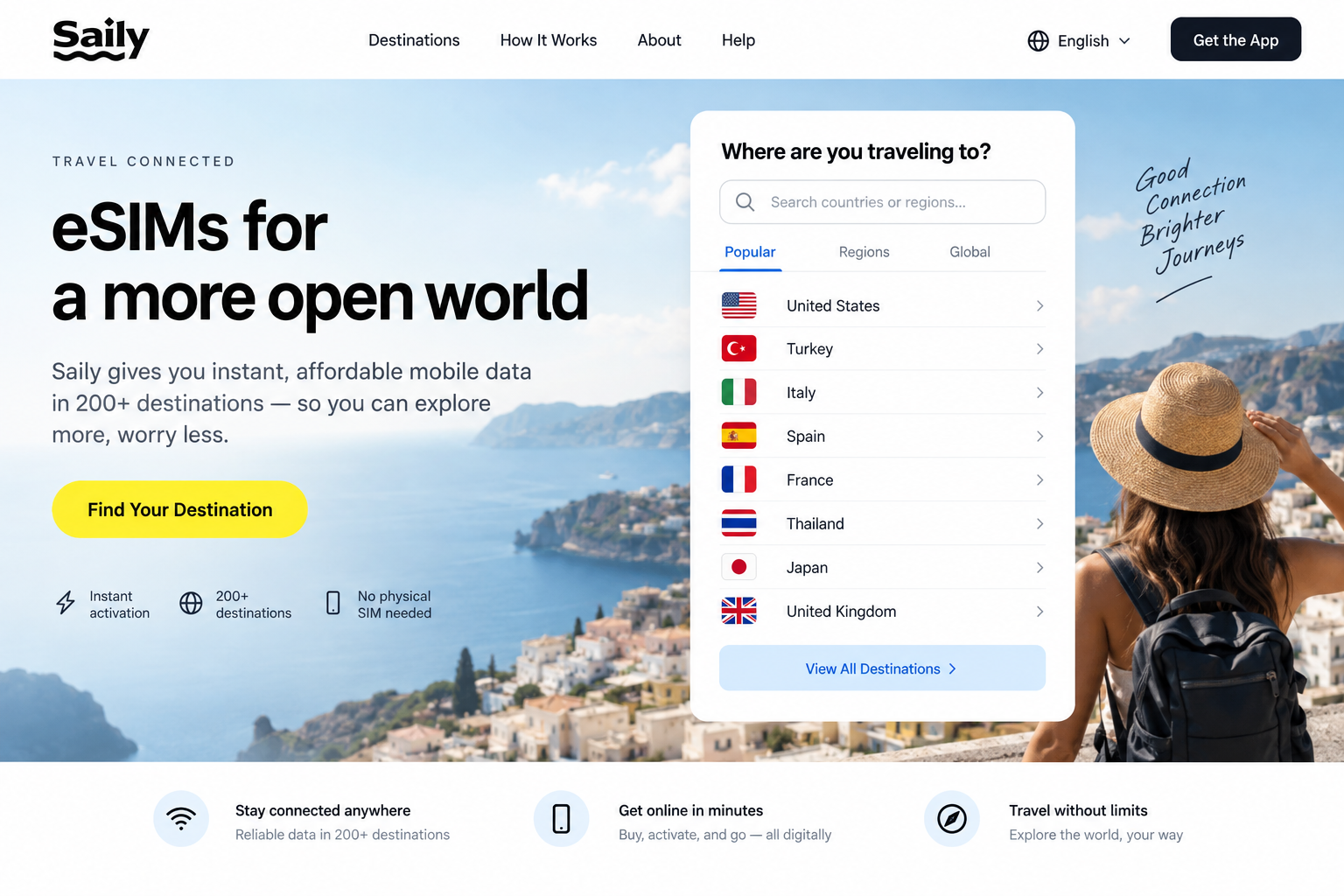
Saily is one of the travel eSIM services competing in this market. Created by Nord Security, the company behind NordVPN, Saily focuses on prepaid mobile data for international travelers, with plans available across more than 200 destinations. The service also combines connectivity with several security-oriented features and, more recently, an optional US phone-number service.
But broad coverage and an attractive app are only part of the decision.
The more useful question is whether Saily provides the right combination of price, data allowance, coverage, convenience, network access, security features, and flexibility for your particular trip.
This Saily review examines those factors in detail. It also compares Saily with Airalo, Nomad, Holafly, traditional roaming, and local SIM cards.
One important limitation should be made clear at the beginning: this review does not claim first-hand network testing. Cellular performance can change considerably according to destination, local carrier, device, congestion, signal strength, and network infrastructure. Where possible, the analysis below separates Saily's documented capabilities from independent observations and practical conclusions.
Quick Verdict
Saily is a strong travel eSIM option for travelers who prioritize simple setup, broad international availability, a polished app, and integrated security features.
Its biggest strengths are its wide destination coverage, straightforward installation, regional and global plans, 24/7 support, hotspot support, and security-oriented features. Saily currently advertises eSIM plans in more than 200 destinations, while its global plan covers 121 countries.
The service is particularly appealing to:
First-time eSIM users
Short- and medium-term international travelers
Multi-country travelers
Travelers who want to prepare connectivity before departure
Users who value privacy and security tools
Travelers who do not need a traditional local phone number
The main limitations are equally important.
Saily's standard travel eSIM is primarily a data solution, although an optional US-based phone-number service is now available. Some destinations may have restrictions, and "unlimited" plans are not equivalent to unlimited full-speed data: current Saily destination pages specify a high-speed daily allowance followed by unlimited data at up to 1 Mbps.
Bottom line: Saily is worth considering if convenience and a well-integrated travel connectivity experience matter more to you than finding the absolute lowest possible price per gigabyte.
What Is Saily?
Saily is a prepaid eSIM service designed for international travelers.
An eSIM, or embedded SIM, is a digital SIM profile stored inside a compatible device. Instead of physically removing your home SIM card and inserting another SIM when you travel, you can download a separate cellular plan onto the device.
Saily provides the mobile-data portion of that experience through its app.
The basic workflow is straightforward:
Choose your destination.
Select a data plan.
Purchase it through Saily.
Install the eSIM before traveling.
Configure the eSIM as your mobile-data line.
Enable the required roaming setting for the Saily profile.
Connect to a local network after arriving.
Saily recommends installing the eSIM before departure and activating it when arriving at the destination. Its official activation documentation also states that the device needs to be eSIM-compatible and carrier-unlocked.
Saily vs a Traditional SIM
With a physical SIM, you normally need to obtain the card, physically insert it, and potentially store your original SIM somewhere safe while traveling.
An eSIM removes those physical steps.
This is especially useful for travelers who:
Change countries frequently
Own a dual-SIM phone
Want to keep their primary SIM available
Do not want to visit a mobile store after landing
Want to configure connectivity before leaving home
The biggest practical advantage is preparation.
Instead of landing in another country and immediately searching for a SIM retailer or public Wi-Fi, you can arrive with your travel connectivity already configured.
Saily vs International Roaming
Roaming allows your home carrier to connect you to partner networks abroad.
That is often the easiest option because your existing phone number remains associated with your regular mobile service.
The downside is that roaming pricing and allowances are determined by your home carrier.
Saily uses a prepaid model instead. You choose the plan and data allowance before traveling, making the cost more predictable.
That predictability is one of the strongest reasons to consider a travel eSIM.
Why Saily Stands Out
Saily operates in a crowded eSIM market, so its differentiation matters.
Several characteristics make the service particularly interesting.
1. Broad international availability
Saily currently advertises plans across more than 200 destinations. Its destination directory also distinguishes individual countries from regional and global options.
That makes Saily suitable for both single-country trips and itineraries involving multiple destinations.
2. Security features are part of the product
Saily is backed by Nord Security, which gives the product a different positioning from many travel eSIM marketplaces.
The service includes security-oriented features such as:
Ad blocking
Web protection
Virtual location features
The exact capabilities and availability should still be checked against the current product description because security tools and plan structures can change. Saily's current destination pages explicitly advertise built-in ad blocker, web protection, and virtual-location functionality.
The important distinction is that an eSIM itself is not a VPN.
The cellular connection and security tools are separate concepts.
3. A single eSIM can support multiple trips
Saily says users can add new destinations to their existing Saily eSIM rather than installing an entirely new eSIM every time they travel.
That can make the service easier to manage for frequent travelers.
4. Regional and global plans
For multi-country travel, a regional plan can be more convenient than purchasing individual country plans.
Saily explains that regional plans bundle multiple countries into one data plan, although the exact countries included depend on the particular region.
The global plan currently lists 121 countries and offers validity periods ranging from 7 days to 365 days depending on the data allowance.
Saily Feature Deep Dive
Saily eSIM Data Plans
What it does
Saily sells prepaid mobile-data plans for individual destinations, regions, and global travel.
How it works
You select a destination and purchase a specific amount of data for a defined validity period.
Current examples from Saily's US plans include:
1 GB for 7 days — $3.99
3 GB for 30 days — $8.99
5 GB for 30 days — $13.99
10 GB for 30 days — $22.99
20 GB for 30 days — $36.99
Unlimited for 15 days — $45.99
These are current US prices and should not be interpreted as universal Saily pricing. Prices vary significantly by destination.
Why it matters
The prepaid model makes it easier to estimate connectivity costs before a trip.
Best use cases
Saily works particularly well for travelers who already have a reasonable estimate of their data consumption.
Limitation
The cheapest advertised price is not necessarily the cheapest cost per gigabyte.
A traveler should compare the actual plan for the destination rather than comparing only the headline starting price.
Expert assessment
Saily's strength here is flexibility rather than a claim of being universally cheapest.
Connectivity and Network Performance
The most important thing to understand about any travel eSIM is that the eSIM provider does not control every part of the cellular experience.
Your actual connection depends on the underlying network available where you are.
Saily destination pages describe supported connectivity as including technologies such as 3G, 4G/LTE, and 5G depending on local network providers.
That means a Saily plan should not be interpreted as a guarantee of a particular speed everywhere.
Actual performance can vary because of:
Local carrier availability
Distance from cell towers
Building penetration
Rural infrastructure
Network congestion
Device compatibility
Supported frequency bands
Signal strength
Local network technology
Temporary outages
A phone displaying 5G does not automatically mean the connection will be faster than another location using 4G.
Similarly, an area theoretically covered by a network may still produce a poor experience inside a building, underground, in a remote region, or during congestion.
Network Selection
Travel eSIM services generally depend on local carrier infrastructure.
Saily destination pages refer to connections through local networks, but travelers should avoid interpreting a provider's advertised network capability as a guarantee that a particular carrier will always be selected or available everywhere.
For important travel, it is sensible to check the exact destination page before purchasing.
International Coverage
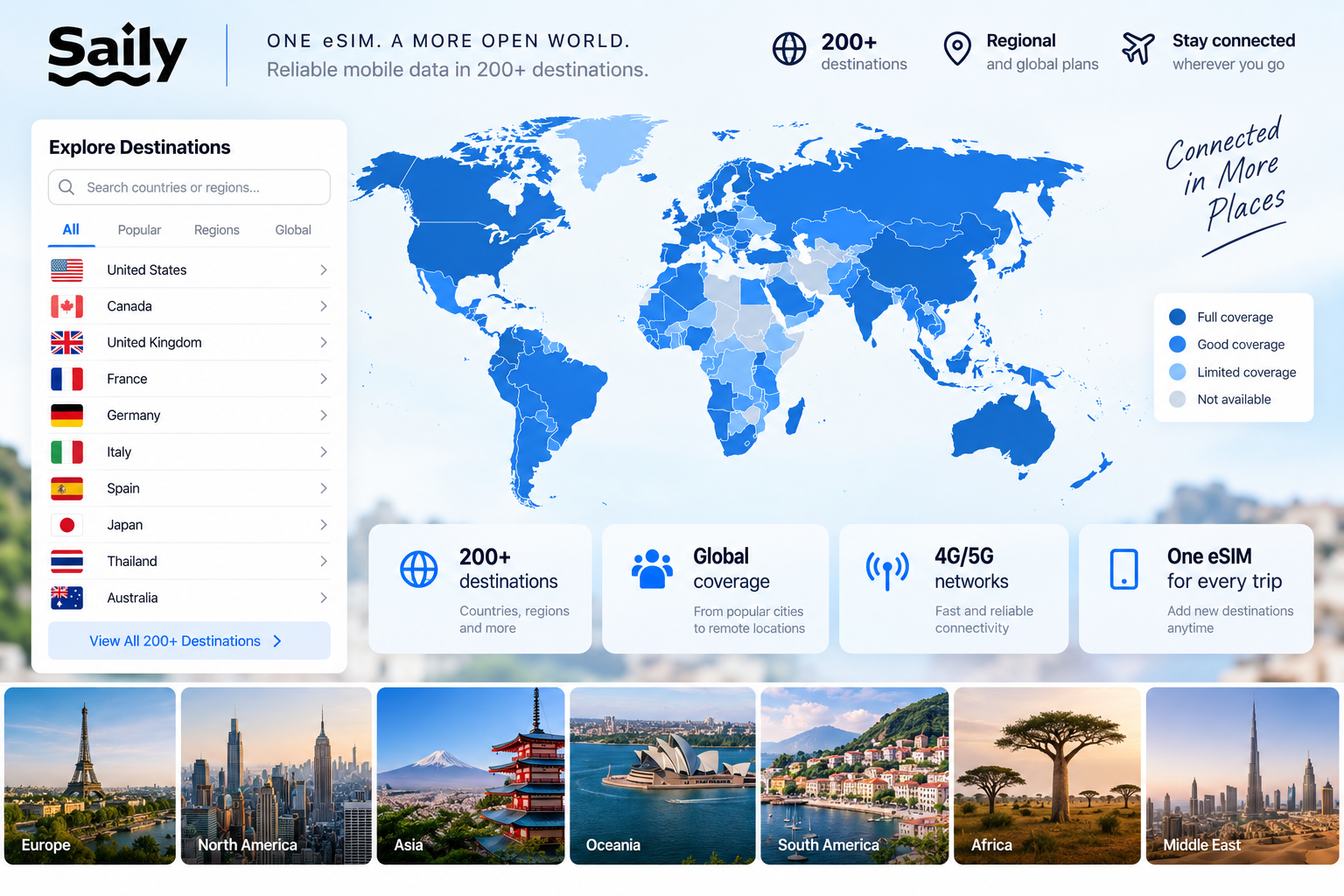
Saily currently advertises service in 200+ destinations. Its current destination directory shows more than 200 entries, including country, regional, global, and specialized options.
The service covers major travel markets across:
Europe
North America
Asia
Oceania
South America
Africa
Middle East
Caribbean destinations
Examples include the United States, Canada, United Kingdom, France, Germany, Italy, Japan, South Korea, Thailand, Vietnam, Australia, New Zealand, India, Indonesia, and many others.
Europe
Europe is one of the areas where a regional plan makes particular sense.
A traveler visiting France, Italy, Switzerland, Germany, and Spain may prefer one regional plan rather than purchasing five country-specific packages.
Saily's current Europe offering includes fixed-data and unlimited options. For example, the current Europe page lists an unlimited 15-day plan at $49.99 with 3 GB/day at unrestricted speed followed by unlimited data at up to 1 Mbps.
Asia
Saily lists regional coverage across Asia and Oceania, with destinations including Japan, South Korea, Thailand, Vietnam, Singapore, Malaysia, Indonesia, India, Australia, and New Zealand.
North America
The United States and Canada are supported through dedicated plans.
The US page currently lists plans from $3.99, while Canada starts at $5.29.
Important coverage warning
"200+ destinations" is useful as a coverage indicator, but it should not replace checking your specific itinerary.
Coverage can differ between:
Country-specific plans
Regional plans
Global plans
Remote territories
Special geographic areas
If your itinerary includes unusual destinations, border regions, islands, or territories, check the exact coverage list before purchasing.
Saily 5G and Network Speed
Saily supports 5G where compatible local networks provide it.
But there is an important distinction between:
5G capability
and
guaranteed 5G performance.
Saily does not control whether a particular physical location has usable 5G coverage.
Even if the local carrier supports 5G, your actual experience can depend on:
Your phone
Your location
Your plan
Local carrier infrastructure
Network congestion
Frequency compatibility
Signal strength
For example, Saily's Italy documentation lists 3G/4G/LTE/5G depending on local network providers.
That is the appropriate way to interpret 5G support: it is available where the underlying network supports it, rather than being a universal speed guarantee.
Saily App Experience
The app is central to the Saily experience.
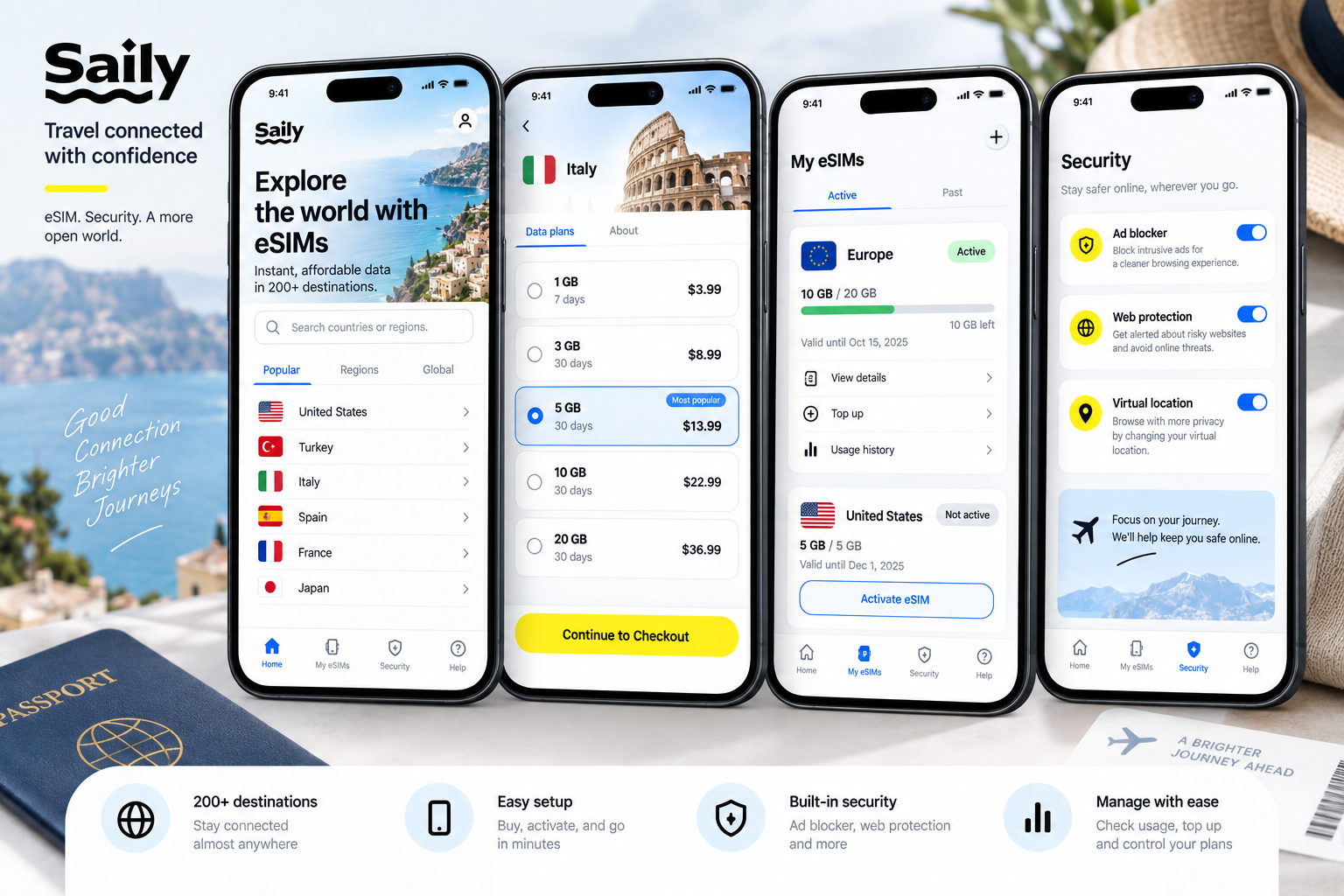
Saily distributes its app through both the App Store and Google Play and states that the service works on eSIM-compatible smartphones running iOS or Android.
The app is designed around several core tasks:
Selecting a destination
Buying a plan
Installing the eSIM
Managing data
Accessing support
Managing security-related features
Managing additional services
This approach is particularly useful for first-time eSIM users because it puts purchasing and installation into one workflow.
App Store and Google Play sentiment
Current public app-store data is broadly positive, but the two ecosystems should not be treated as identical.
The Vietnamese App Store listing currently shows a 4.8/5 rating from 89 ratings.
Google Play currently shows approximately 4.5/5 from more than 95,000 reviews.
Large review counts are useful because they provide more context than a handful of reviews, but aggregate ratings do not prove that every traveler will have a smooth experience.
The Google Play listing also shows recent negative feedback involving login or connectivity-related issues, illustrating why individual travel experiences can differ even when the overall rating is strong.
Installation and Activation
For a first-time eSIM user, installation is one of the most important parts of the buying decision.
Saily's official activation instructions recommend installing the eSIM before travel.
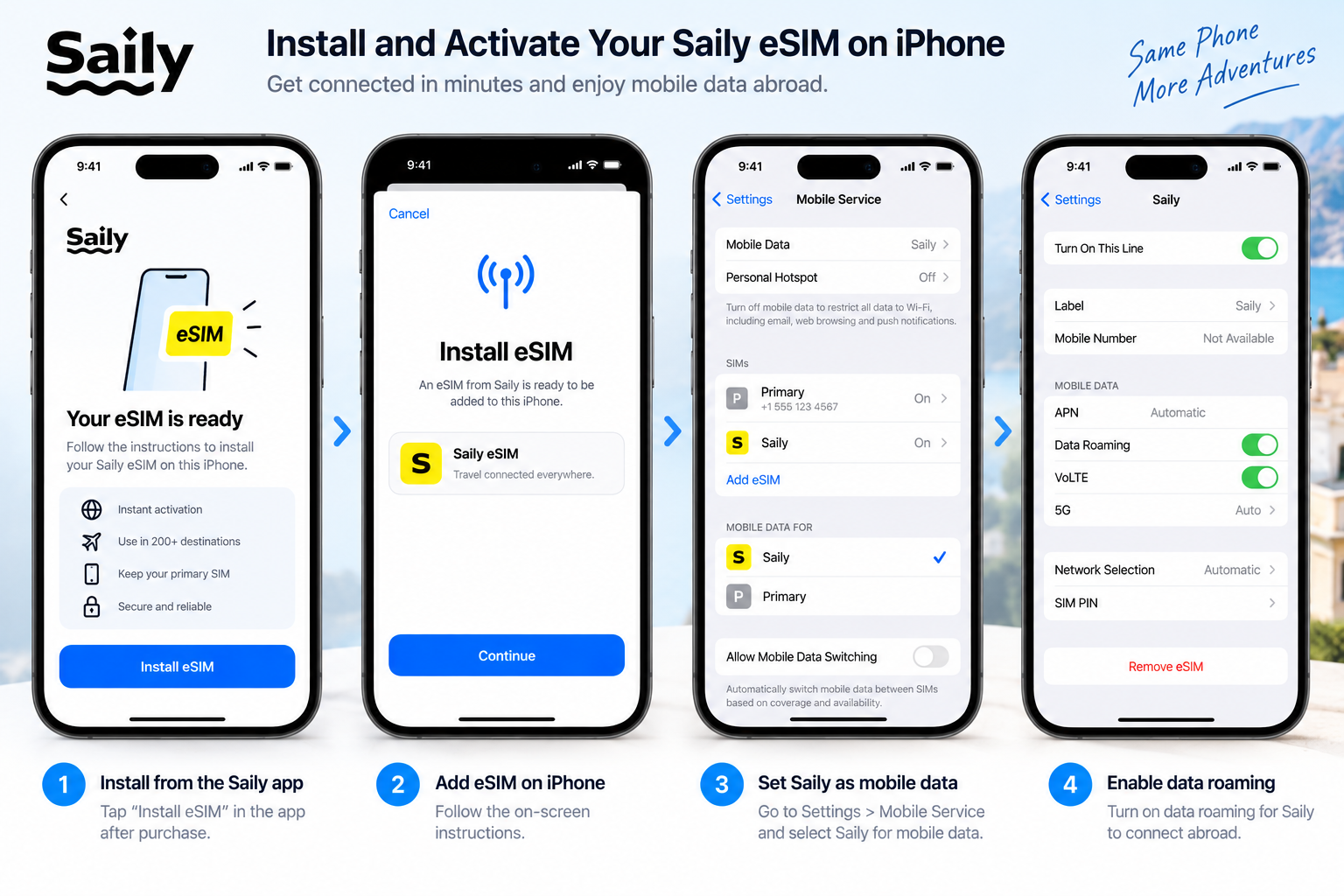
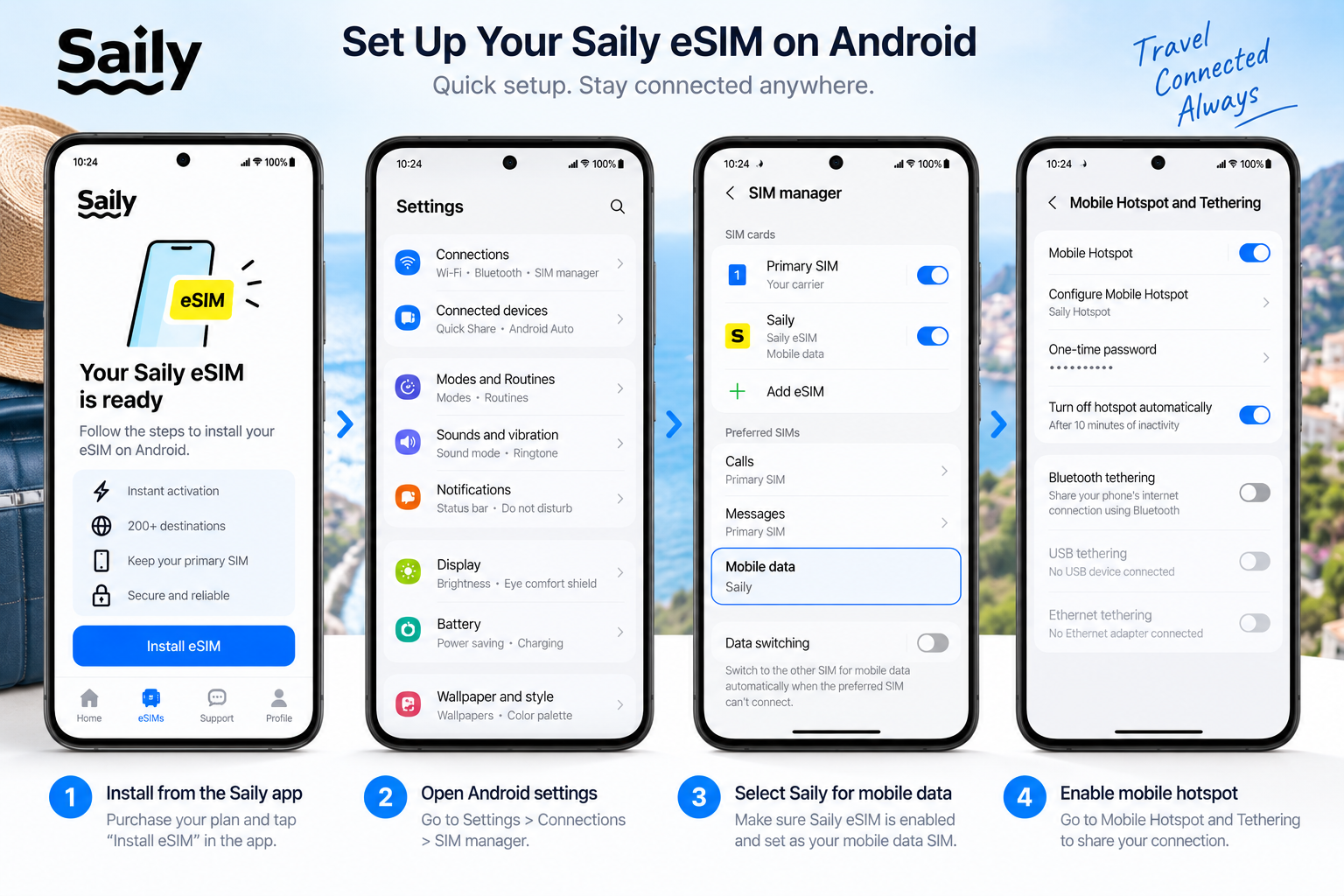
Step-by-step installation workflow
1. Check device compatibility
Confirm that the phone supports eSIM.
2. Check that the phone is carrier-unlocked
A carrier-locked phone may prevent you from using a travel eSIM.
3. Purchase the plan
Select the destination and appropriate data allowance.
4. Install the Saily eSIM
Use the Saily app and follow the device-specific installation instructions.
5. Keep your normal SIM available if required
Dual-SIM devices can potentially maintain the primary line while using Saily for data.
6. Select Saily as the mobile-data line
This is critical.
If your phone continues using your home carrier for mobile data, you could still incur roaming charges.
7. Enable data roaming for Saily
Saily's official setup instructions specifically tell users to enable data roaming for the Saily eSIM profile.
8. Disable automatic data switching
On compatible devices, disable the feature that automatically switches mobile data between SIMs.
9. Arrive at the destination
The plan is designed to activate automatically when you reach the destination, assuming the required settings are enabled.
10. Confirm connectivity
Check that:
Saily is selected for mobile data
The eSIM is enabled
Data roaming is enabled for Saily
Your primary SIM is not accidentally providing mobile data
What If Saily Does Not Activate?
Saily's troubleshooting documentation recommends checking several settings.
If activation does not occur:
Confirm the Saily eSIM is enabled.
Confirm Saily is selected for mobile data.
Confirm data roaming is enabled.
Check the APN configuration.
On Android, keep the Saily app open for several minutes if automatic APN configuration is required.
Contact Saily support if the issue persists.
One important travel rule is to install and configure the eSIM before leaving home.
That gives you time to solve compatibility or installation problems while you still have reliable Wi-Fi and access to your normal carrier.
Device Compatibility
Saily requires:
An eSIM-compatible smartphone
A carrier-unlocked device
An operating system/device configuration that supports the required eSIM functionality
The fact that a phone is new does not automatically mean every regional version supports eSIM.
This is particularly relevant for devices purchased in certain markets where eSIM functionality may differ by model or region.
iPhone
Check the exact model and regional configuration rather than assuming that every iPhone variant supports eSIM.
Android
Android support varies considerably by manufacturer and model.
Samsung, Google Pixel, and other modern Android devices may support eSIM, but compatibility must be verified for the specific model.
Dual SIM
Dual-SIM functionality is one of the strongest reasons to use a travel eSIM.
It can allow travelers to retain their primary SIM while using Saily as the data line.
The critical setting is ensuring that mobile data is assigned to the correct SIM.
Data Management
The amount of data you need depends more on how you use your phone than how long you are traveling.
A traveler who mainly uses messaging, email, and maps can consume dramatically less data than someone who streams video every day.
Activity | Typical data impact | Why it matters |
|---|---|---|
Messaging | Low | Text messages use very little data |
Low | Usually manageable on small plans | |
Maps/navigation | Low–moderate | Usage rises with repeated map loading |
Social media | Moderate | Photos and short videos consume more |
Music streaming | Moderate | Continuous streaming adds up |
Video calls | High | Real-time video can consume significant data |
HD video streaming | Very high | One of the fastest ways to use a data allowance |
Cloud backup | Very high | Automatic uploads can consume large amounts |
Remote work | Moderate–high | Depends heavily on meetings and file transfers |
The most important practical lesson is that background activity can be more important than travelers realize.
Automatic photo synchronization, app updates, cloud backups, and video autoplay can consume data without the user actively browsing.
Light-data traveler
A 1–3 GB plan may be enough for a short trip if most heavy activity occurs over Wi-Fi.
Moderate-data traveler
A 5–10 GB plan provides considerably more flexibility for navigation, messaging, social media, and occasional media consumption.
Heavy-data traveler
A 20 GB or unlimited plan is more appropriate if mobile data is being used as the primary internet connection.
Hotspot and Tethering
Saily supports hotspot functionality.
Its official instructions provide separate hotspot setup guidance for iOS and Android. On iOS, users can enable Personal Hotspot through the mobile-data settings; on Android, the corresponding option is Mobile Hotspot and Tethering.
This is particularly useful for:
Laptops
Tablets
Secondary phones
Work devices
Travel companions
However, hotspot availability should not be confused with unlimited data.
If you connect a laptop and begin downloading large files, synchronizing cloud storage, or participating in video conferences, your data consumption can increase rapidly.
For business travelers, this is one of the most important considerations when choosing the plan size.
Security and Privacy
Security is one of Saily's more distinctive positioning points.
The product includes security-oriented functionality such as:
Ad blocking
Web protection
Virtual location functionality
These features are particularly relevant to travelers who frequently use unfamiliar networks.
However, it is important not to overstate what they do.
An eSIM is not automatically a VPN
An eSIM provides cellular connectivity.
It does not, simply because it is an eSIM, make all internet traffic anonymous or secure.
Similarly:
Cellular data ≠ VPN
Ad blocking ≠ complete privacy protection
Web protection ≠ immunity from phishing
eSIM ≠ protection against account compromise
Saily's security tools should therefore be evaluated as additional software features rather than as an inherent property of eSIM technology.
The connection between Saily and Nord Security is nevertheless relevant because Saily's product strategy clearly incorporates privacy and security into its travel proposition.
Saily Phone Number
Saily has expanded beyond pure data connectivity.
The company currently offers an optional US-based phone number.
The add-on costs $0.99/month according to Saily's current website.
The number can support:
Voice calls
Standard SMS
Data connectivity through the Saily app
Saily says voice calls are supported in more than 130 countries, while the exact calling model depends on the plan.
There are important limitations.
The service does not support:
MMS
Premium-rate numbers
Call forwarding
Saily also notes that not every service will accept its US number for OTP or 2FA.
This makes the phone-number service useful for some travelers, but it should not be viewed as a universal replacement for a local SIM number.
Real-World Travel Use Cases
Short Vacation
For a three- to seven-day vacation, Saily can be a convenient solution because travelers can purchase a relatively small plan and avoid buying a physical SIM.
This is particularly attractive when the traveler wants:
Maps
Messaging
Ride-hailing
Restaurant searches
Travel bookings
Social media
A small fixed-data plan can be sufficient if hotel and café Wi-Fi handle heavier activity.
Long Vacation
For a two- or four-week trip, the calculation changes.
The traveler should compare:
Total data
Validity
Price per GB
Ability to top up
Whether the plan expires before the trip ends
Saily currently offers plans ranging from small fixed allowances to larger 20 GB packages and unlimited options, depending on destination.
Multi-Country Trip
This is one of Saily's strongest use cases.
Regional and global plans reduce the need to purchase a separate plan every time the traveler crosses a border.
Saily specifically provides regional bundles for multiple countries.
However, travelers should verify that every country on the itinerary is included.
Business Travel
Saily can be particularly useful for business travelers who need:
Email
Slack or Teams
Maps
Ride-hailing
Cloud applications
Authentication
Video calls
Laptop hotspot
The main consideration is data consumption.
A business traveler who regularly joins video conferences through a laptop should not select a small plan simply because the trip is short.
Digital Nomads
This is a more complicated case.
A digital nomad may require:
Large data allowances
Stable connectivity
Hotspot
Video conferencing
Cloud services
Long validity
Multiple-country coverage
Saily can satisfy several of these requirements, but a traveler who relies entirely on mobile data for work should compare the cost against local SIMs and fixed broadband options.
For extended stays, a local mobile plan may become more economical.
Backpackers
Saily is attractive for backpackers because it removes the need to repeatedly find SIM stores.
Regional plans can be particularly convenient when crossing multiple countries.
The main issue is coverage in remote areas.
A traveler planning to spend substantial time outside cities should investigate the specific local network coverage rather than relying solely on the provider's overall country count.
Family Travel
Saily is purchased per eSIM/device.
A single eSIM is therefore not automatically equivalent to internet service for an entire family.
Hotspot can provide a practical sharing mechanism where supported, but it can also consume data quickly.
For families with several devices, compare the total cost of:
One larger plan + hotspot
Multiple individual eSIMs
A local SIM with generous tethering
International Students
Students staying abroad for several months have different requirements from tourists.
A travel eSIM can be useful during arrival and the initial period, but long-term students may find local carrier plans more economical.
The need for a local phone number is another reason to consider a traditional local mobile service.
Saily Pricing and Plans
Saily pricing varies by destination, data allowance, validity, and plan type.
There is no single universal Saily price.
Current US pricing illustrates the structure:
US plan | Validity | Current price |
|---|---|---|
1 GB | 7 days | $3.99 |
3 GB | 30 days | $8.99 |
5 GB | 30 days | $13.99 |
10 GB | 30 days | $22.99 |
20 GB | 30 days | $36.99 |
Unlimited | 15 days | $45.99 |
These figures reflect Saily's current US destination page and can change.
The structure is more important than the individual numbers.
Saily offers:
Small plans for light users
Medium plans for normal travelers
Larger fixed-data plans
Unlimited-style plans
Regional plans
Global plans
Optional phone-number functionality
Saily Ultra for a premium subscription experience
The current global plans include:
Global data | Validity | Current price |
|---|---|---|
1 GB | 7 days | $8.99 |
2 GB | 15 days | $16.49 |
5 GB | 60 days | $33.99 |
10 GB | 180 days | $56.99 |
20 GB | 365 days | $66.99 |
50 GB | 365 days | $129.99 |
Saily currently lists these global plans as covering 121 countries.
Unlimited Does Not Mean Unlimited Full-Speed Data
This is one of the most important pricing details.
For example, the current US unlimited plan provides:
5 GB/day at unrestricted speed
Unlimited subsequent data at up to 1 Mbps
The current Europe unlimited plan uses a 3 GB/day high-speed allowance followed by unlimited data at up to 1 Mbps.
That means heavy users should not interpret the word "unlimited" as unlimited full-speed 5G.
Value for Money
Saily's value proposition depends heavily on the traveler.
Strong value when:
You want connectivity immediately after landing.
You do not want to visit a SIM shop.
You need multiple countries.
You value easy setup.
You want integrated security features.
You need hotspot.
You prefer predictable prepaid spending.
Less compelling when:
You only care about the lowest possible price per GB.
You are staying in one country for several months.
You need a local phone number.
A local SIM is dramatically cheaper.
You require very high volumes of full-speed data.
The correct question is therefore not:
"Is Saily cheap?"
It is:
"Is Saily's combination of price and convenience worth the premium over the cheapest available alternative for my trip?"
For many short-term travelers, the answer can be yes.
Saily vs Local SIM
Factor | Saily | Local SIM |
|---|---|---|
Setup | Digital | Usually physical or store-based |
Convenience | Very high | Moderate |
Local number | Optional US number | Usually available |
Multi-country travel | Strong | Usually weaker |
Local carrier choice | Depends on plan | Often direct |
Long-term value | Variable | Often strong |
Physical store required | No | Often |
Device requirement | eSIM-compatible | SIM-compatible |
A local SIM is often the better choice for long-term residents.
Saily is generally better for travelers who value speed and convenience.
A traveler arriving for a week may not care about saving a few dollars if obtaining a local SIM requires an hour at an airport store.
Someone staying six months probably should care.
Saily vs International Roaming
Factor | Saily | Carrier roaming |
|---|---|---|
Cost predictability | High | Depends on carrier |
Setup | Requires eSIM setup | Usually automatic |
Existing number | Primary number remains separate | Primary number |
Data pricing | Prepaid | Carrier-dependent |
Multi-country use | Strong with regional/global plans | Carrier-dependent |
Risk of accidental roaming | Manageable with correct settings | Can be significant |
Convenience | High after setup | Extremely high |
Roaming wins on simplicity.
Saily wins when the traveler wants more control over cost and data.
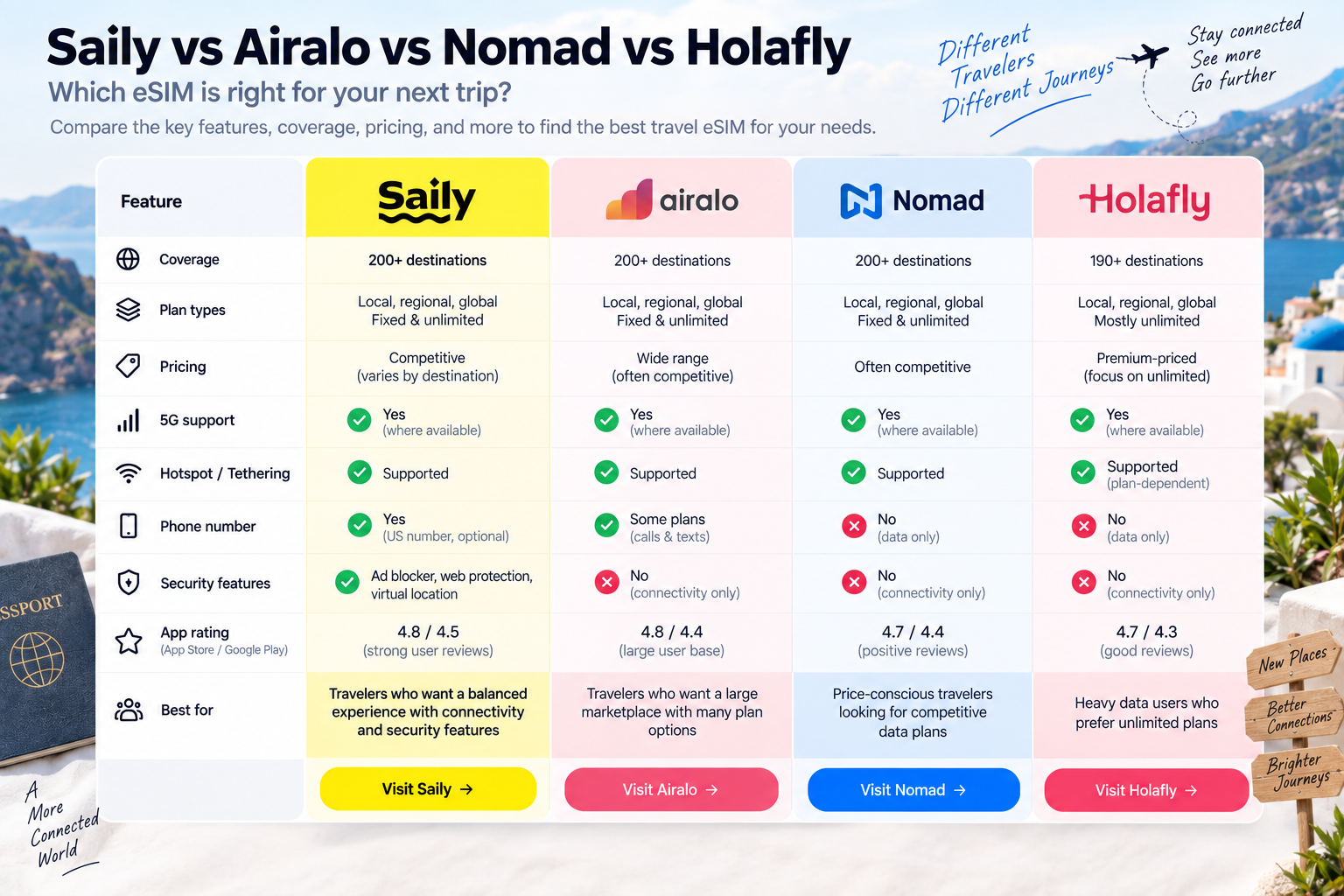
Saily vs Airalo
Airalo is one of Saily's closest competitors.
Airalo currently offers local, regional, and global eSIMs across more than 200 locations, with both fixed and unlimited options. Its official site also says the platform has more than 30 million users.
Factor | Saily | Airalo |
|---|---|---|
Coverage | 200+ destinations | 200+ locations |
Regional plans | Yes | Yes |
Global plans | Yes | Yes |
Unlimited options | Yes | Yes |
Hotspot | Supported | Supported where device/network allow |
Security tools | Strong emphasis | Less central to positioning |
App languages | Standard travel-app experience | 53 languages |
Phone number | Optional US number | Some plans support calls/texts |
Best advantage | Security + integrated experience | Large marketplace + breadth |
Airalo has an advantage for travelers who want a mature marketplace with a large catalog of local, regional, and global options.
Saily is more compelling for travelers who value the integration of connectivity with security tools.
Saily is better for: travelers who prioritize simplicity, security features, and a streamlined experience.
Airalo is better for: travelers who want a large marketplace and extensive plan selection.
Saily vs Nomad
Nomad is another major travel eSIM provider with 200+ destinations and local, regional, and global plans.
Nomad can be particularly competitive in destinations where its data pricing is low.
Factor | Saily | Nomad |
|---|---|---|
Coverage | 200+ destinations | 200+ destinations |
Local plans | Yes | Yes |
Regional plans | Yes | Yes |
Global plans | Yes | Yes |
Hotspot | Supported | Generally supported depending on plan/device |
Security features | Major differentiator | Less central |
Pricing | Destination-dependent | Often highly competitive |
Best for | Integrated travel/security experience | Price-conscious plan shoppers |
Saily is better for: users who value the broader product ecosystem.
Nomad is better for: users who are comfortable comparing individual plans and prioritize competitive data pricing.
Saily vs Holafly
Holafly takes a somewhat different approach by emphasizing unlimited-data products.
That makes the comparison especially interesting.
Factor | Saily | Holafly |
|---|---|---|
Fixed data | Yes | Yes, depending on destination |
Unlimited plans | Yes | Major focus |
Full-speed unlimited | Not necessarily | Subject to provider/fair-use conditions |
Hotspot | Supported | Plan-dependent |
Multi-country | Regional/global options | Regional options |
Best for | Flexible data + security | Heavy-data travelers |
Holafly's terms explicitly state that unlimited plans can be subject to a network provider's fair-use policy.
Saily's current unlimited plans similarly demonstrate why "unlimited" needs careful interpretation: high-speed usage is capped per day on current examples, after which data remains available at reduced speed.
Saily is better for: travelers who want fixed-data choices and a broader feature set.
Holafly is better for: travelers whose primary priority is having a large or unlimited-style data allowance and who understand the associated conditions.
Competitor Comparison
Provider | Main strength | Coverage | Best for |
|---|---|---|---|
Saily | Simplicity + security | 200+ destinations | Balanced travelers |
Airalo | Marketplace breadth | 200+ locations | Plan variety |
Nomad | Competitive pricing | 200+ destinations | Price-conscious users |
Holafly | Unlimited-oriented plans | Broad global coverage | Heavy data users |
Local SIM | Local pricing/service | Country-specific | Long-term stays |
There is no universal winner.
The best choice depends on whether the traveler prioritizes:
Price
Convenience
Unlimited data
Security
Local phone service
Long-term use
Multi-country coverage
Top Saily Features Worth Knowing About
1. 200+ destination coverage
Useful for travelers who frequently cross borders.
2. Regional plans
Useful for multi-country itineraries.
3. Global plans
Useful for frequent international travelers.
4. One reusable eSIM
Saily allows users to add new destinations to the existing eSIM.
5. Automatic destination activation
The plan is designed to activate when arriving at the supported destination.
6. Hotspot
Useful for laptops and tablets.
7. Security features
Ad blocking and web protection distinguish Saily from a pure connectivity product.
8. 24/7 support
Saily advertises round-the-clock customer support.
9. Optional US phone number
Useful for travelers who require calls and SMS.
10. Long-validity global plans
The current global catalog includes plans with validity up to 365 days.
11. Saily credits
Current plan pages display Saily credits on eligible purchases, with examples showing 3% credit.
12. Saily Ultra
The premium subscription combines global data with travel perks and Nord Security products.
Pros and Cons
Pros
Coverage across 200+ destinations
Easy digital installation
Regional and global options
No physical SIM required
Hotspot support
Security features integrated into the experience
24/7 support
Optional US phone number
Long-validity global plans
Strong app-store ratings
Useful for multi-country travel
Cons
Not necessarily the cheapest option in every destination
Prices vary significantly by country
Unlimited plans can reduce speed after the high-speed allowance
Standard travel connectivity should not be treated as a local phone service
Some users may experience activation or connectivity problems
eSIM compatibility is required
Carrier unlocking is required
Local SIMs can be better value for long stays
Phone-number functionality has limitations
Who Should Use Saily?
First-time eSIM users
Yes.
The app-driven workflow is one of Saily's strongest advantages.
Frequent international travelers
Yes.
The ability to reuse an eSIM and purchase additional destinations can simplify repeated travel.
Short-term tourists
Yes.
Prepaid plans remove much of the friction associated with obtaining a local SIM.
Multi-country travelers
Strong yes.
Regional and global plans are particularly useful here.
Business travelers
Yes, with the right data allowance.
Hotspot support makes Saily more practical for laptop-based work.
Digital nomads
Maybe.
Saily can work well as a travel connectivity layer, but long-term users should compare local mobile plans.
Students
Usually as a temporary solution.
For months-long stays, local service may provide better value.
Budget travelers
Compare first.
Saily can be affordable, but it is not guaranteed to be the cheapest option in every destination.
Heavy-data users
Potentially.
Unlimited plans can help, but the daily high-speed limits must be understood.
Light-data users
Yes.
Small plans can be sufficient for maps, messaging, email, and occasional browsing.
Who Should Not Use Saily?
Saily may not be ideal if:
Your phone does not support eSIM.
Your phone is carrier-locked.
You need a permanent local phone number.
You plan to stay in one country for several months.
A local SIM is dramatically cheaper.
You require a specific local carrier.
You need enormous quantities of full-speed data.
Your destination is outside the exact coverage of the selected plan.
These are not necessarily flaws in Saily.
They are situations where the travel-eSIM model itself may not be the best fit.
Best Saily Option for Different Trips
Trip type | Recommended approach | Why |
|---|---|---|
3 days | Small fixed-data plan | Most travelers need relatively little data |
7 days | Small/medium plan | Good balance of cost and convenience |
14 days | Medium or larger plan | More flexibility for maps and social media |
30 days | 10–20 GB or unlimited | Depends heavily on usage |
Multi-country | Regional plan | Avoids multiple purchases |
Global travel | Global plan | Convenient across many destinations |
Business trip | 10–20 GB+ | Hotspot and video calls can increase usage |
Heavy-data trip | Unlimited-style plan | Better for sustained usage, with speed conditions |
Light-data trip | 1–5 GB | Suitable for basic connectivity |
These are usage recommendations rather than claims that one specific Saily plan is universally optimal.
Practical Travel Workflows
Before the Trip
Check whether your device supports eSIM.
Confirm that the device is carrier-unlocked.
Check the destination's Saily coverage.
Compare local, regional, and global plans.
Estimate your data requirements.
Purchase the plan.
Install the eSIM while connected to reliable Wi-Fi.
Label the Saily eSIM clearly in your phone settings.
Configure the Saily profile according to the instructions.
Keep your primary SIM available if you need your normal number.
Saily specifically recommends installing the eSIM before departure.
At the Airport
If you have not yet arrived at the destination, avoid unnecessary changes to your primary SIM.
Once you arrive:
Enable the Saily eSIM.
Select it for mobile data.
Enable data roaming for Saily.
Disable automatic data switching.
Disable mobile data on the primary SIM if necessary.
Wait for network registration.
Test a website or messaging application.
After Landing
Do not assume that simply installing an eSIM means the phone is automatically using it for data.
Check the actual mobile-data line.
This is particularly important on dual-SIM phones.
During the Trip
Monitor:
Remaining data
Background usage
Hotspot usage
Streaming
Cloud synchronization
If your data consumption is unexpectedly high, investigate which apps are responsible before purchasing additional data.
Before Returning Home
Switch mobile data back to your primary SIM.
Disable the Saily profile if no longer needed.
Restore your normal data settings.
Confirm that your home carrier is selected.
Troubleshooting
eSIM Cannot Be Installed
Confirm the phone supports eSIM.
Confirm the phone is carrier-unlocked.
Connect to Wi-Fi.
Restart the device.
Reopen the Saily app.
Follow the current Saily installation instructions.
eSIM Does Not Activate
Confirm the eSIM is enabled.
Select Saily for mobile data.
Enable data roaming for Saily.
Disable automatic mobile-data switching.
Check APN settings.
Contact Saily support if necessary.
No Signal
Move to an area with stronger reception.
Restart the device.
Toggle airplane mode.
Confirm the Saily profile is active.
Check whether the destination is supported.
Connected but No Internet
Confirm Saily is the selected data line.
Confirm roaming is enabled for Saily.
Check APN settings.
Restart the phone.
Try another location.
Slow Connection
Remember that slow service can be caused by:
Network congestion
Weak signal
Local infrastructure
Device limitations
Network technology
Location
A slow connection does not automatically prove that the eSIM itself is defective.
5G Is Not Available
Check:
Whether the destination supports 5G
Whether the local network provides 5G in your location
Whether your device supports the required bands
Whether the phone is configured for 5G
Hotspot Does Not Work
Confirm Saily is active.
Confirm mobile data works directly on the phone.
Enable Personal Hotspot or Mobile Hotspot.
Check APN settings if required.
Restart the hotspot connection.
Saily provides separate iOS and Android hotspot instructions.
Customer Reviews and User Sentiment
Public customer feedback is generally positive, although individual experiences vary.
The current Google Play listing shows approximately 4.5/5 from more than 95,000 reviews, while Saily's own app page reports strong ratings across the App Store and Google Play.
The App Store listing currently shows 4.8/5 from 89 ratings in the Vietnamese storefront.
Positive feedback commonly emphasizes:
Convenience
Easy setup
Travel connectivity
Cost savings compared with roaming
App usability
Negative feedback demonstrates the other side:
Login issues
Activation problems
Connectivity problems
Perceived pricing
Destination-specific performance
For example, a recent Google Play review describes a problem with the app recognizing the user's login after arrival.
Another recent review criticized Saily's price compared with buying a local SIM.
These reviews should not be interpreted as universal evidence of failure.
Travel eSIM experiences can differ according to:
Destination
Local carrier
Device
Signal
Configuration
Network congestion
User expectations
The important takeaway is that Saily has substantial positive adoption, but no travel eSIM can eliminate the variability of international cellular networks.
Customer Support
Saily advertises 24/7 customer support and provides help-center documentation covering installation, activation, hotspot configuration, refunds, troubleshooting, and account-related questions.
The help documentation is particularly useful because many eSIM problems are configuration problems rather than network problems.
Before contacting support, check:
eSIM status
Mobile-data selection
Data roaming
APN
Network selection
Device compatibility
Carrier lock
Remaining data
This can significantly shorten troubleshooting time.
Refund Policy
Saily's current refund policy distinguishes between plans that have not been activated and plans that have already been used.
For an uninstalled or unactivated data plan, Saily says a full refund can be requested within 30 days of purchase.
For activated plans, a full refund is not guaranteed, although Saily may consider partial or full refunds in certain circumstances, including serious quality issues or situations where more than 99% of the plan's data remains unused.
This distinction matters.
Travelers should not purchase an eSIM assuming that an activated plan can always be refunded.
Is Saily Legit?
Yes, Saily is a legitimate commercial eSIM service.
Saily was created by Nord Security, the company behind NordVPN. Saily's own company information identifies the service as part of the Nord Security ecosystem.
Saily launched its first eSIM plans in March 2024 with coverage across more than 160 countries and subsequently expanded to 200+ destinations.
The service has:
Official iOS and Android apps
Public pricing
Help documentation
Refund documentation
Customer support
A substantial user base
Public app-store reviews
A documented corporate relationship with Nord Security
These are all reasonable indicators of an established commercial service.
Legitimacy does not mean every connection will be perfect.
It means there is substantial evidence that Saily is a real operating travel-connectivity business rather than an anonymous or unverifiable eSIM storefront.
Is Saily Safe?
Saily can be considered a legitimate and reasonably security-conscious travel connectivity option, but users should not interpret it as complete internet security.
The distinction is important.
Saily's eSIM provides cellular data.
Its additional security functionality can provide protections such as web protection and ad blocking.
But users still need to practice normal security hygiene:
Use strong passwords.
Enable multi-factor authentication.
Avoid suspicious links.
Keep the operating system updated.
Be cautious with sensitive accounts on unfamiliar networks.
Use a reputable VPN when appropriate.
Do not assume that mobile data makes every online activity secure.
Saily's relationship with Nord Security is relevant because privacy and security are explicitly part of the company's product positioning.
Is Saily Worth It?
For many international travelers, yes—but not universally.
Saily is most compelling when the traveler values:
Convenience
Fast digital setup
Multi-country connectivity
Predictable prepaid spending
Hotspot
Security features
App-based management
It is less compelling when the primary goal is:
The absolute cheapest data
Long-term local service
A permanent local phone number
Maximum full-speed data
Direct access to a particular local carrier
The value proposition is therefore highly dependent on the trip.
A seven-day tourist trip and a six-month study-abroad stay should not be evaluated using the same criteria.
Decision Guide
Choose Saily if...
You want to install your connectivity before departure.
You are visiting multiple countries.
You want a simple app-based experience.
You care about security features.
You want hotspot capability.
You prefer prepaid pricing.
You do not need a traditional local number.
Consider Airalo if...
You want a very large eSIM marketplace.
You want extensive plan variety.
You want to compare many local, regional, and global options.
You prefer a highly established travel-eSIM marketplace.
Airalo currently advertises coverage in 200+ locations and more than 30 million users.
Consider Nomad if...
Price is one of your highest priorities.
You are comfortable comparing destination-specific plans.
You want local, regional, and global choices.
Nomad currently advertises coverage in 200+ destinations.
Consider Holafly if...
Your trip involves heavy data usage.
You prefer unlimited-style plans.
You understand that unlimited plans can still be subject to fair-use or network conditions.
Consider a local SIM if...
You are staying for months.
You need a local phone number.
You want local carrier service.
You need the lowest possible long-term cost.
You need very large data allowances at local-market pricing.
FAQ
What is Saily?
Saily is a prepaid travel eSIM service created by Nord Security. It provides mobile data plans across more than 200 destinations.
Is Saily legit?
Yes. Saily is an established travel eSIM service created by Nord Security, the company behind NordVPN.
Is Saily safe?
Saily offers security-oriented features such as web protection and ad blocking, but an eSIM itself is not a complete security solution.
How does Saily work?
You purchase a plan, install the eSIM, configure it for mobile data, and connect to a supported local network when you arrive.
Does Saily support 5G?
Yes, where supported by the local network, destination, device, and plan. Saily does not guarantee identical 5G performance everywhere.
Where does Saily work?
Saily currently advertises plans in more than 200 destinations.
How do I install Saily?
Install the Saily app, purchase a plan, follow the in-app installation instructions, and configure the eSIM before departure.
Does Saily work on iPhone?
Yes, provided the particular iPhone and regional version support eSIM and the device is carrier-unlocked.
Does Saily work on Android?
Yes, on compatible and unlocked Android devices.
Can I use Saily with dual SIM?
Yes. Dual-SIM functionality can allow you to keep your primary SIM while using Saily for mobile data.
Does Saily support hotspot?
Yes. Saily provides hotspot instructions for both iOS and Android.
Can I use Saily in multiple countries?
Yes. Regional and global plans are designed for multi-country travel.
How much data do I need?
Light travelers may need only 1–3 GB, while travelers who frequently stream, video-call, or hotspot may need 10–20 GB or more.
Does Saily provide a phone number?
Saily currently offers an optional US-based phone number.
Can I make calls with Saily?
Yes, through the optional phone-number service. Saily says voice calling is supported in more than 130 countries, subject to plan conditions.
Can I receive SMS?
Yes, the optional Saily phone-number service supports standard SMS, but MMS is not supported.
Does Saily work without Wi-Fi after activation?
Yes. Once the eSIM is installed and connected to a supported cellular network, Wi-Fi is not required for ordinary mobile-data use.
What happens when my data runs out?
The behavior depends on the plan. Travelers should check the current plan's terms and available top-up options rather than assuming that connectivity will automatically continue.
Can I buy more data?
Saily supports additional plan purchases and destination management through its service. Exact top-up availability should be checked for the specific plan.
Is Saily better than Airalo?
Not universally. Saily has stronger differentiation around security and product integration, while Airalo offers a very broad marketplace and plan selection.
Is Saily better than Nomad?
It depends on the destination and price. Nomad can be very competitive on data pricing, while Saily offers a broader security-oriented product experience.
Is Saily better than Holafly?
It depends on usage. Saily offers fixed-data plans and unlimited-style options, while Holafly emphasizes unlimited plans.
Is Saily worth it?
For travelers who prioritize convenience, simple setup, broad coverage, and integrated security features, Saily can be very good value. Travelers focused exclusively on the lowest price may find better alternatives.
Internal Linking Suggestions
The following topics would naturally support this article:
Best Travel eSIMs
How Does an eSIM Work?
How to Install an eSIM on iPhone
How to Install an eSIM on Android
International Roaming Guide
How Much Mobile Data Do You Need While Traveling?
Best eSIMs for Europe
Best eSIMs for Asia
Best eSIMs for the USA
Saily vs Airalo
Saily vs Nomad
Saily vs Holafly
Travel Internet Guide
How to Avoid Roaming Charges
These links should be inserted only where they naturally help readers continue researching a specific topic.
People Also Ask Questions
These questions are useful secondary search intents for future content expansion:
Is Saily eSIM reliable?
Is Saily better than Airalo?
Is Saily cheaper than roaming?
Does Saily work in Europe?
Does Saily work in Japan?
Does Saily work in China?
Does Saily work in the USA?
Does Saily work in Vietnam?
Can Saily be used for hotspot?
Does Saily support 5G?
Does Saily have unlimited data?
Does Saily have a phone number?
How long does a Saily eSIM last?
Can I reuse my Saily eSIM?
Can I use Saily on two phones?
Does Saily work without Wi-Fi?
Can I keep my regular SIM while using Saily?
Is Saily good for digital nomads?
Is Saily good for business travel?
What happens if Saily stops working?
Final Verdict
Overall Assessment
Saily has developed into a serious travel eSIM option rather than simply another low-cost data marketplace.
Its strongest characteristic is the combination of connectivity, app usability, broad destination coverage, and security-oriented features.
The service currently covers more than 200 destinations, offers local, regional, and global plans, supports hotspot functionality, provides 24/7 support, and offers an optional US phone number.
Biggest Strengths
The strongest reasons to choose Saily are:
Easy digital setup
Broad international coverage
Regional and global plans
Reusable eSIM approach
Hotspot support
Security features
Strong app-store sentiment
24/7 support
Optional phone-number functionality
Biggest Weaknesses
The biggest limitations are:
Pricing varies considerably by destination
It is not always the cheapest eSIM
Unlimited plans have high-speed usage conditions
Long-term travelers may get better value from local SIMs
Phone-number functionality is not equivalent to a universal local number
Cellular performance depends on local networks and conditions
Best For
Saily is particularly well suited to:
International tourists, frequent travelers, first-time eSIM users, multi-country travelers, business travelers, and users who value a simple connectivity experience with additional security features.
Not Ideal For
It is less attractive for:
Long-term residents, travelers who need a local number, users seeking the absolute lowest cost per GB, or people requiring extremely large amounts of uninterrupted full-speed data.
Final Recommendation: Is Saily Worth It?
Yes, Saily is worth considering for most short- and medium-term international trips, but it should not automatically be considered the best eSIM for every traveler.
Its strongest advantage is not simply price.
It is the combination of convenience, broad coverage, app-based management, prepaid control, hotspot capability, and security features.
If your priority is landing in another country with connectivity already prepared, Saily makes a compelling case.
If your priority is finding the cheapest possible data plan, compare Saily against Airalo, Nomad, and local SIMs for your exact destination.
If you need unlimited-style usage, pay close attention to the high-speed allowance rather than stopping at the word "unlimited."
And if you are staying in one country for months, investigate local mobile plans before committing to a travel eSIM.
The most accurate conclusion is therefore:
Saily is a strong all-around travel eSIM, especially for travelers who value simplicity and security, but its value depends on your destination, data usage, trip duration, and need for local mobile services.


